TBD. I have several 120V inverters, but I'd get a 240V if I need faster charging or if it would be significantly more efficient. Wattage depends on what Slate allows through their charger at 120V or 240V.
Hopefully if the EVSE tells the Slate it can do 16/20A at 120V it will do that. I could be wrong but I don’t know of any EVSE that would communicate 24//30A at 120V, say from an RV TT30. From 240V it will probably do 48/60A (11.5 kW) although the spec says 11kW.
The Slate mobile EVSE is said to do 240V/40A from a typical 14-50 but interestingly, it appears the neutral plug prong can be rotated to use a 14-60.
Hopefully if the EVSE tells the Slate it can do 16/20A at 120V it will do that. I could be wrong but I don’t know of any EVSE that would communicate 24//30A at 120V, say from an RV TT30. From 240V it will probably do 48/60A (11.5 kW) although the spec says 11kW.
The Slate mobile EVSE is said to do 240V/40A from a typical 14-50 but interestingly, it appears the neutral plug prong can be rotated to use a 14-60.
From the FAQ: "... you can use a regular 120V household outlet... works with NEMA 14-30, 14-50 and 14-60 outlets. "
The specs show up to 1.9 kW level 1 (a 20 amp connection), up to 11 kW level 2 (60 amps), and up to 120 kW level 3 (375 amp?).
From the FAQ: "... you can use a regular 120V household outlet... works with NEMA 14-30, 14-50 and 14-60 outlets. "
The specs show up to 1.9 kW level 1 (a 20 amp connection), up to 11 kW level 2 (60 amps), and up to 120 kW level 3.
From the FAQ: "... you can use a regular 120V household outlet... works with NEMA 14-30, 14-50 and 14-60 outlets. "
The specs show up to 1.9 kW level 1 (a 20 amp connection), up to 11 kW level 2 (60 amps), and up to 120 kW level 3.
US wiring rules consider EVs to be a continuous load. Continuous loads are only allowed to use 80% of a breakers capacity. Common 120 volt breakers and outlets in the US are 15 amp, and 20 amp. Garages have required at least one 20 amp circuit installed for at least the last 30 years, older garages may have 15 amp outlets.
So, the charger's rate at 120 volts will almost certainly be limited to 12 amps (1440 watts maximum) and/or 16 amps (1920 watts). It is possible, but I think much less likely, that it may include a 120 volt 30 amp outlet option (24 amps, 2880 watts maximum).
I'll be fine with 1400 watts, but would prefer 1900 watts. I don't plan to install or use 240 volt charging at home. My home is old enough that the plug installed in 1962 on the south wall is 15 amps, the plug added to the north wall in the 1970's 20 amps.
Yeah, gas engines are only 20-35% efficient, the rest is waste heat and friction. Anti-EV arguments will try to point out transmission losses, charging losses, etc, but they just don't compare to gas engine losses. What gas has going for it is capacity and refill speed, but definately not efficiency.
I know that info is buried in the FAQ, but I strongly believe is it outdated and not current.
I believe that the portable charger will come as it has been visually depicted - NEMA 14-50, with a single 5-15 adapter. Portable EVSE with multiple plug adapters are not particularly common, I believe VW and Hyundai include them, but otherwise, I've seen few NACS evse (at least at lower cost) that include multiples.
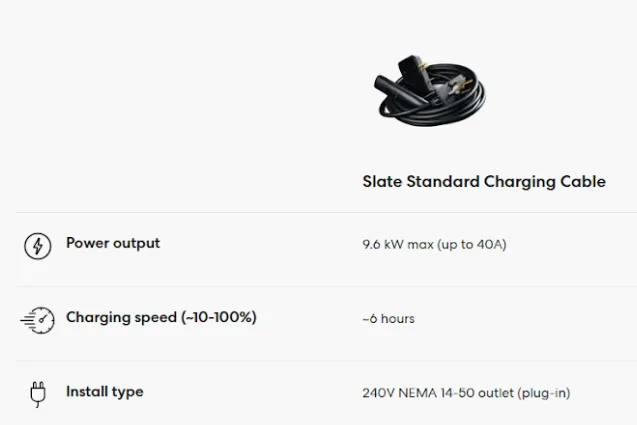
I wanted clarification, so I reached out a couple days ago to Slate support with detailed questions about the included portable chargers specs. Not surprisingly, I got squishy non-specifics, but the rep did include a graphic showing this:
I believe (using their supplied EVSE), that we will be limited to 12a on L1, but we will have up to 40a on L2 (I half expected 32a max). I do not expect we will receive a 14-30 adapter (a question avoided in reps response).
I have been studying the various 14-50 EV rated receptacles to see which ones support lighter wire gauges (10ga, 12ga), as that is my preference for L2.
Sustainables conversion rates are in the high 30% range. Its free energy no doubt but still most of the potential is not captured, which means larger footprints and infrastructure cost. There is no free lunch.
I know that info is buried in the FAQ, but I strongly believe is it outdated and not current.
I believe that the portable charger will come as it has been visually depicted - NEMA 14-50, with a single 5-15 adapter. Portable EVSE with multiple plug adapters are not particularly common, I believe VW and Hyundai include them, but otherwise, I've seen few NACS evse (at least at lower cost) that include multiples.
I wanted clarification, so I reached out a couple days ago to Slate support with detailed questions about the included portable chargers specs. Not surprisingly, I got squishy non-specifics, but the rep did include a graphic showing this:
I believe (using their supplied EVSE), that we will be limited to 12a on L1, but we will have up to 40a on L2 (I half expected 32a max). I do not expect we will receive a 14-30 adapter (a question avoided in reps response).
I have been studying the various 14-50 EV rated receptacles to see which ones support lighter wire gauges (10ga, 12ga), as that is my preference for L2.
I am pleased to learn Slate is now reporting charge times from 10-100%. It's the standard across many other EVs, especially those with LFP battery chemistry. Begin your nightly charge after 10 PM (that's when my TOU plan* changes to super off peak) and my Slate is fully charged at around 4 am.
I know that info is buried in the FAQ, but I strongly believe is it outdated and not current.
I believe that the portable charger will come as it has been visually depicted - NEMA 14-50, with a single 5-15 adapter. Portable EVSE with multiple plug adapters are not particularly common, I believe VW and Hyundai include them, but otherwise, I've seen few NACS evse (at least at lower cost) that include multiples.
I wanted clarification, so I reached out a couple days ago to Slate support with detailed questions about the included portable chargers specs. Not surprisingly, I got squishy non-specifics, but the rep did include a graphic showing this:
I believe (using their supplied EVSE), that we will be limited to 12a on L1, but we will have up to 40a on L2 (I half expected 32a max). I do not expect we will receive a 14-30 adapter (a question avoided in reps response).
I have been studying the various 14-50 EV rated receptacles to see which ones support lighter wire gauges (10ga, 12ga), as that is my preference for L2.
Here is a quote taken today from the Slate FAQ. "Believe it or not, you can use a regular 120V household outlet to charge your electric vehicle at home. For faster charging, you can plug in to a 240V appliance outlet. The included Standard Charging Cable works with NEMA 14-30, 14-50 and 14-60 outlets." I notice in the included charger picture there is a white lever around the neutral pin of the 14-50 plug. If that turns that pin 90 degrees it becomes a 14-60 plug.
It is likely the neutral is not actually used when charging on 240 volts, but I guess it could sense the position of the terminal. I have seen a few 240 volt chargers than can be wired for a 6-30 plug (2 hots and a ground no neutral, not to be confused with an older 10-30 dryer plug that has 2 hots and a neutral no ground). It would be cool if the included 120 volt adapter could sense the position of that neutral terminal to choose between 1400 and 1900 watts.
I'll be fine with 1400 watts, but would prefer 1900 watts. I don't plan to install or use 240 volt charging at home. My home is old enough that the plug installed in 1962 on the south wall is 15 amps, the plug added to the north wall in the 1970's 20 amps.