
Grill dimensions?

htmlprofessional

New Member
Joined
May 29, 2026
Threads
1
Messages
4
Reaction score
0
Location
MT
Vehicles
audi
Slatelets and headlight covers look pretty easy to design and print. Any info on the dimensions of the area between the headlights? I'm guessing we'll have to break it up into three pieces with seams or something to get it to fit on a normal size printer.

 

2thlesswithta2s

Active Member
First Name
Ron
Joined
May 17, 2026
Threads
0
Messages
27
Reaction score
30
Location
NY
Vehicles
Subaru Toyota
Slatelets and headlight covers look pretty easy to design and print. Any info on the dimensions of the area between the headlights? I'm guessing we'll have to break it up into three pieces with seams or something to get it to fit on a normal size printer.
They will have stl files & design dimensions available. Everything is intended to be open source. You can use a print service to get large prints. Here's one. There are others.

https://partguys.io/
 
OP
OP
htmlprofessional

htmlprofessional

New Member
Joined
May 29, 2026
Threads
1
Messages
4
Reaction score
0
Location
MT
Vehicles
audi
They will have stl files & design dimensions available. Everything is intended to be open source. You can use a print service to get large prints. Here's one. There are others.
Thanks for the feedback, but I'd rather DIY the whole thing then pay a couple hundred dollars to a print service. Worse case I would buy my own super expensive printer. I'm just trying to get an idea of which way would work best based on how big it is.
 

KevinRS

Well-Known Member
First Name
Kevin
Joined
Jul 4, 2025
Threads
6
Messages
1,425
Reaction score
1,637
Location
California
Vehicles
Nissan Versa
Thanks for the feedback, but I'd rather DIY the whole thing then pay a couple hundred dollars to a print service. Worse case I would buy my own super expensive printer. I'm just trying to get an idea of which way would work best based on how big it is.
One issue is materials. You don't really want standard PLA on a car part unless you are just prototyping or maybe putting on a holiday light cover you will be taking off in a few weeks anyway. You need heat resistance, and also UV resistance for parts that will be external.
 

Adam W

Well-Known Member
First Name
Adam
Joined
Apr 26, 2025
Threads
7
Messages
277
Reaction score
834
Location
Washington
Vehicles
Honda CRV
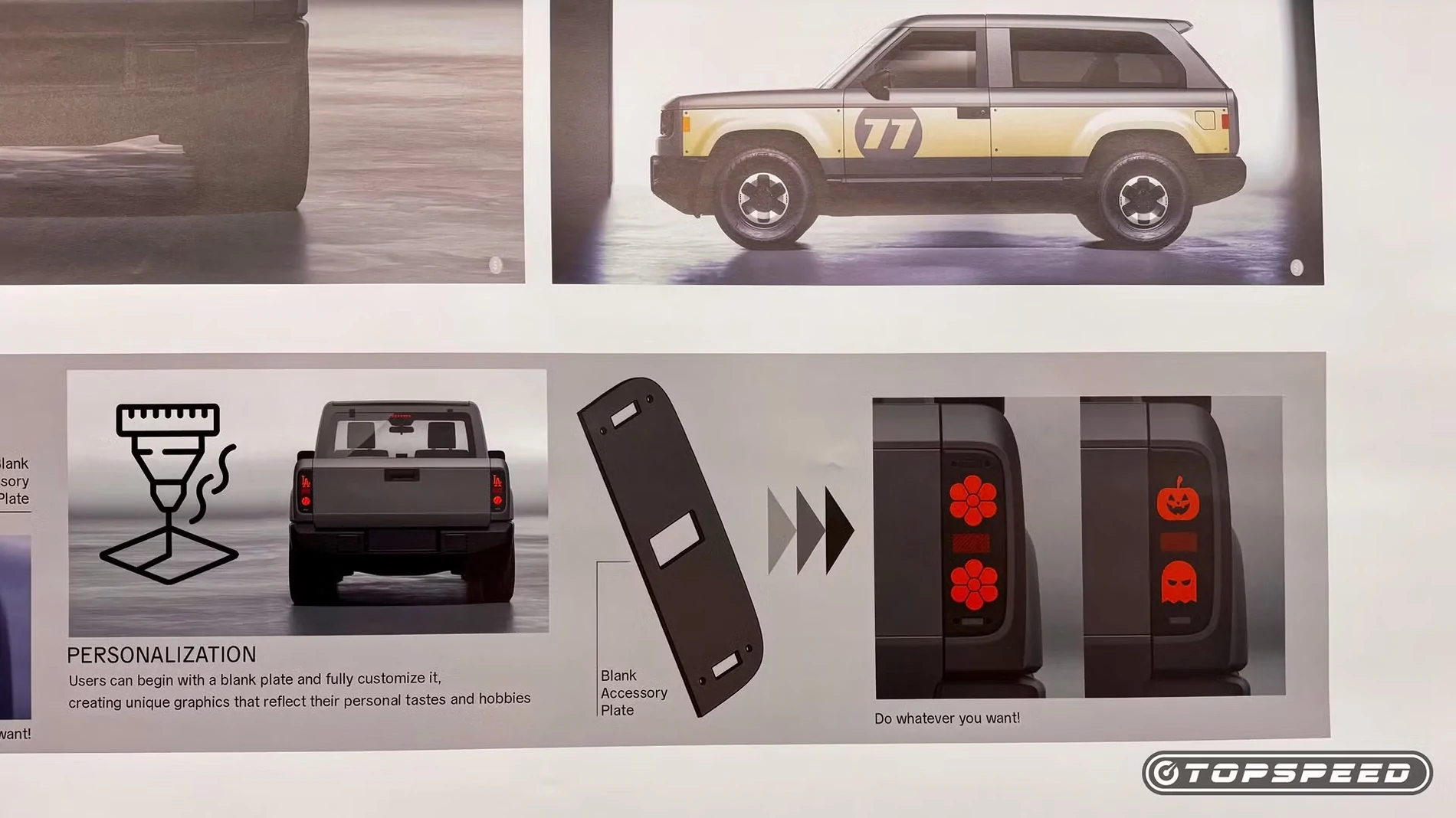
I believe they also said they will be selling blanks of some parts, presumably the same injection molded plastic and quality as the OEM parts. Then DIY-ers just need to CNC route out their custom designs. Might be a better option than 3D printing the full piece.
 

2thlesswithta2s

Active Member
First Name
Ron
Joined
May 17, 2026
Threads
0
Messages
27
Reaction score
30
Location
NY
Vehicles
Subaru Toyota
One issue is materials. You don't really want standard PLA on a car part unless you are just prototyping or maybe putting on a holiday light cover you will be taking off in a few weeks anyway. You need heat resistance, and also UV resistance for parts that will be external.
Probably polycarbonate or nylon would be the best choices for consumer printing. PEEK would be good for commercial grade.
 

KevinRS

Well-Known Member
First Name
Kevin
Joined
Jul 4, 2025
Threads
6
Messages
1,425
Reaction score
1,637
Location
California
Vehicles
Nissan Versa
Probably polycarbonate or nylon would be the best choices for consumer printing. PEEK would be good for commercial grade.
That's the thing, those materials aren't exactly entry level materials in 3d printing. Even ABS and ASA are not printable on all printers.
 
OP
OP
htmlprofessional

htmlprofessional

New Member
Joined
May 29, 2026
Threads
1
Messages
4
Reaction score
0
Location
MT
Vehicles
audi
That's the thing, those materials aren't exactly entry level materials in 3d printing. Even ABS and ASA are not printable on all printers.
I'm planning on doing ASA. I've already setup my air filtration system. It wasn't that hard or expensive.
 
OP
OP
htmlprofessional

htmlprofessional

New Member
Joined
May 29, 2026
Threads
1
Messages
4
Reaction score
0
Location
MT
Vehicles
audi
I guess I can just ballpark it. The front of the slate is about 70 inches wide, which would make that grill about 28 inches by 8 inches. That converts to about 700 mm. So outside pieces would be 200mm(maybe a little more) and inside piece would be 300mm.
 

2thlesswithta2s

Active Member
First Name
Ron
Joined
May 17, 2026
Threads
0
Messages
27
Reaction score
30
Location
NY
Vehicles
Subaru Toyota
That's the thing, those materials aren't exactly entry level materials in 3d printing. Even ABS and ASA are not printable on all printers.
An FDM printer capable of 300C with an enclosure should be able to handle it, but might need extra tuning & operator competence. Filament would also need to be dried, especially for nylon.
 

jhevil

New Member
First Name
JH
Joined
Jun 7, 2026
Threads
1
Messages
4
Reaction score
4
Location
US
Vehicles
F-150 Lightning BEV
I believe they also said they will be selling blanks of some parts, presumably the same injection molded plastic and quality as the OEM parts. Then DIY-ers just need to CNC route out their custom designs. Might be a better option than 3D printing the full piece.
I'd love to see this at a reasonable price. Can you share where you saw / heard that the covers would be whole and premade for end users to customize? I cant seem to find it. I already have a capable 3D printer that can handle more difficult materials, but I will avoid taking that route if I can CNC a tough part.

I have several ideas to take the stock signal covers and cut them directly or (more likely) use the stock covers as a template so that I can print my own if the STL files are not readily available.
 

Adam W

Well-Known Member
First Name
Adam
Joined
Apr 26, 2025
Threads
7
Messages
277
Reaction score
834
Location
Washington
Vehicles
Honda CRV
Can you share where you saw / heard that the covers would be whole and premade for end users to customize? I cant seem to find it. I already have a capable 3D printer that can handle more difficult materials, but I will avoid taking that route if I can CNC a tough part.
It was mentioned at an early press event / design studio tour. Here's a closeup of a poster from the TopSpeed writeup. It's the same event from this Rich Rebuilds video, though I don't remember if he touches on this specific aspect.

2026-slate-truck-4-1.webp
 

Sl8Ready

Member
First Name
Stephen
Joined
Dec 17, 2025
Threads
0
Messages
6
Reaction score
4
Location
Kentucky
Vehicles
Bertone X1/9, Can Am Ryker
I'd prob use PETG for season prints. I'm setup for ASA/ABS is i want something more permanent.
 

KevinRS

Well-Known Member
First Name
Kevin
Joined
Jul 4, 2025
Threads
6
Messages
1,425
Reaction score
1,637
Location
California
Vehicles
Nissan Versa
I am planning to test some HT-PLA and the glass filled variant, will print some swatches and leave them in my car in 100F+ high desert weather. Some videos I've watched testing them seemed to show that they would resist the heat.
UV resistance is another matter, and will require consideration for long term use.
I do have PETG but it does soften before HT-PLA
I am not set up for ASA/ABS
 

Gargamel

New Member
First Name
T
Joined
Jun 11, 2026
Threads
0
Messages
4
Reaction score
10
Location
Ohio
Vehicles
NA
It seems like there might be some confusion here about what materials to use when, and how to go about doing that. I'll offer my unsolicited advice.

Yes, ASA (and to some degree ABS) is the King for outdoor materials. An ASA part designed for outdoor use can have a lifespan of 10+ years. But the issue comes with the requirements for printing, but as @htmlprofessional mentioned above, it's not a hard setup to get a regular bed slinger setup for ASA. Most of the time, just a simple pop-up style enclosure to keep the drafts out works. You'll need to let it heat soak first to for 20 minutes or so from the heated bed. This isn't a big problem, and can be automated through some G-code editing, a simple G4 (dwell) command after the bed temp is set could do the trick. Once you get that dialed in, you can have the slicer insert the code automatically for that filament. That is, of course, if your printer uses G4.

Of course the other issue is the fumes. That's a completely different discussion, and is really dependent on your particular setup.

But, for those that don't want to deal with that, take a look at PCTG and PCTG-CF. PCTG is basically PETG's more user friendly and vastly superior long lost brother. Structurally, chemical resistance, and impact wise, PCTG is superior to ASA. It prints even easier than PETG, and the cost has dropped enough over the last few months you can get it for about the same price. Even the weird Chinesium brands I've tried have been amazing. Where it does fail is the UV resistance when compared to ASA though. The -CF versions are supposed to be better, with estimates 4-5 years of life expectancy outdoors, but those will require hardened nozzle; but those upgrades are fairly easy to obtain cheaply in today's market. -CF will resist the UV better than regular, supposedly because the fibers help block the light.

An FDM printer capable of 300C with an enclosure should be able to handle it, but might need extra tuning & operator competence. Filament would also need to be dried, especially for nylon.
I know a lot of the bigger name printers come pretty idiot proof these days, with their (really well made) built-in filament profiles, but everyone that owns a printer should familiarize themselves with the calibration process. It's only a handful of prints, takes a couple few hours, and really let's you dial in the settings. Not every manufacturer has the same exact formulation for the same materials, and you might need to create and tweak a specfic profile.

As for Drying,I consider it a requirement for all filaments. I run my printer off a drybox setup, and have a seperatedry box for actively drying the filament. Only reason I have two is because the first one doesn't get hot enough for all my materials, otherwise I'd just have one dual one. And they were both <$40 each. I keep all my rolls in vacuum sealed bags (that's when they actually hold a seal. They're of dubious quality). If I think a roll might be wet, it gets dried. The active box has two spots, One that's printing, and the second spot for what's on deck. If there's anything I've learned, if you're ever having the slighest issue with a print, assume moisture first.


I am planning to test some HT-PLA and the glass filled variant, will print some swatches and leave them in my car in 100F+ high desert weather. Some videos I've watched testing them seemed to show that they would resist the heat.
UV resistance is another matter, and will require consideration for long term use.
I do have PETG but it does soften before HT-PLA
I am not set up for ASA/ABS
Everything I've seen about HT-PLA is that it will fail in every other aspect in regards to being an automotive part. PCTG will deform at a slightly lower temperature, but excels in every other aspect. The PLA will breakdown over a relatively short amount of time due to moisture. And you have to anneal it to get the temp resistance, which usually mucks up your dimensional stability. Give the PCTG I mentioned a try. I think you'll like it.

PEEK would be good for commercial grade.
I'm going to be paying enough a month already for the truck, I don't want to double it just for accessories! :) /s


TLDR (Why do we put these at the end?): Go with ASA if you can. If you can't get the setup to work, try PCTG.

Oh, and sorry for the long first post!
 
 
Top