
KevinRS
Well-Known Member
- First Name
- Kevin
- Joined
- Jul 4, 2025
- Threads
- 5
- Messages
- 1,061
- Reaction score
- 1,237
- Location
- California
- Vehicles
- Nissan Versa
With truck sales, customer choice may be partially overridden by need. A lot of those truck sales were for businesses, that NEEDED a truck.I suppose it is hyperbole to say there is no correlation, but my assertion is that it is a fairly weak correlation, and not durable. There was a CBO study a number of years ago on it, and I think they found that in the mid 2000s, a $0.60/gal change in gas pricing was linked to about a 4-5% change in market share between small cars and SUV/trucks. That's not nothing, but it isn't the sea change usually described.
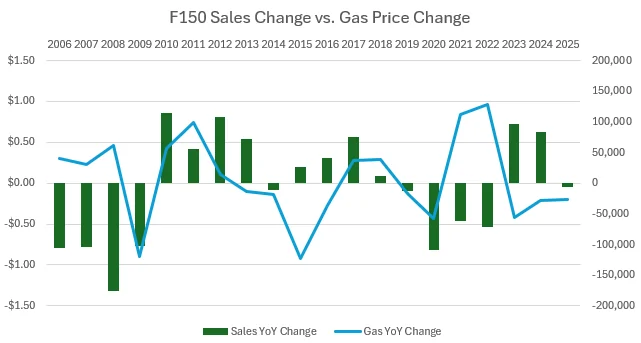
Looking quickly at F150 sales, here is a chart of the YoY change in F150 sales overlaid with the YoY change in average gas prices. Again, you can see a little influence, but it isn't strong. The early 2010's were great years for F150 sales, even while gas prices were increasing.
2015-2017 are a bit more "as expected", gas prices are dropping and sales are going up. 2020 to 2022 sees an increase in gas prices and a drop in sales, but COVID and the massive economic shocks there seem to outweigh the gas price element. 2023 and 2024 also great years for trucks, even with reasonably high prices again.

So really I think my point is not that people entirely ignore fuel prices, but that we aren't actually talking about that big of a range of changes over 20 years, and there are much bigger things that people are looking at when choosing their vehicle. You said yourself that you chose the Tundra over the Tacoma when faced with the same economic conditions.
If the numbers left out actual trucks, and just compared sales of small and larger passenger vehicles, they might be more meaningful. Even better if it compared high and low MPG passenger vehicles.
Last edited: