
Small battery Slate (150 mi) has better driving dynamics?

Kopsis

Well-Known Member
First Name
David
Joined
Dec 7, 2025
Threads
0
Messages
175
Reaction score
466
Location
Arizona
Vehicles
Kia EV6
I think you are probably right. If you take the bill of material and count the lines(unique SKUs) that is the # of parts.

There's some recent evidence to support this interpretation. Note how Slate used to say "600 parts", yet in recent interviews it's "800 parts". That change seems to coincide with the change from their original plan to procure the body-in-white as a completed subassembly to procuring the stamped pieces and assembling it themselves.
 

tubes

Well-Known Member
First Name
Tubes
Joined
Jun 6, 2026
Threads
8
Messages
504
Reaction score
968
Location
NC
Vehicles
Honda Odyssey, Subaru Legacy
I think you are probably right. If you take the bill of material and count the lines(unique SKUs) that is the # of parts. Next to the part # and description is a quantity field, if you add that up that is the number of pieces. So when they are saying 800 parts they are saying 800 lines on their bill of material. Now take for example, the motor/axle assembly which probably has an integrated inverter. That is being supplied by a Chinese company that has a factory in Michigan. That is probably 1 SKU for that entire assembly. Slate is not counting the # of ingredients that went into that assembly they are buying the completed assembly so to them it is 1 part.

Yeah, the motor likely has over 100 parts alone. When I was watching the Munro video of them walking under the vehicle, the only solution I had to "parts" was SKUs.
 

metroshot

Well-Known Member
First Name
Pat
Joined
Apr 30, 2025
Threads
8
Messages
453
Reaction score
508
Location
CA
Website
www.kudo-ume-farms.com
Vehicles
Mach E + Honda PHEV
I can see both things being true: LFP for the standard range, NCM for the extended. That would reduce the weight differential and potentially make the LR more attractive for some while allowing the SR to have a lower price.
This is what Ford did for their EVs.

Starting in 2023 Job 2:
SR = LFP
ER = NMC
 

E90400K

Well-Known Member
First Name
Francis
Joined
Apr 26, 2025
Threads
9
Messages
1,597
Reaction score
1,654
Location
Under a Bridge in the Middle of the Mid Atlantic
Vehicles
A Ford truck
I was thinking about this as I cut the grass yesterday. What is a part? A SKU? I mean, there's gotta be hundreds of fasteners alone. Each one of those isn't a part, I assume. But if they made an effort to attach the panels with just 3 types of fasteners, that would be 3 parts? I'm fixated on fasteners and body panels because in recently working on my Honda and Toyota, I shake my head over the 10s of different types of push-pin connectors they use to attach panels.
Being I studied manufacturing engineering as my college degree, I was a member of the student branch of the Society of Automotive/Aerospace Engineers. I've been a car geek since I was a kid. I've been interested in and studied how automobiles are designed and manufactured. I learned well before the internet was a thing that cars are basically comprised of 30,000 to 40,000 individual parts, which includes electronic circuit board components, fasteners, ball bearings, bearing races, engine internals, etc. - you get the point. So, when a year ago CEO Barman said the same thing, that the Slate is manufactured with less than (just) 800 parts vs. the typical pickup truck of 3,000 to 4,000, my ears really perked up. I don't believe it. Maybe there are 800 SKU assemblies tracked on the production line that make up the final assembly, but still I even don't believe that.

A few weeks ago here on the forum we got into the argument about this part count topic. Several members tried to justify that the 4,000 typical part count includes the ICE. One internet influencer cited in that thread said an engine has 10,000 parts alone. I couldn't laugh harder. I actually went through an exercise to determine the part count in the BMW N52 engine (I've owned 2 of them - so I'm very familiar with the parts for the N52) and the exploded part schematics are available at "realoem.com". Best I could determine is the N52 has about 1,098 individual parts and even less part numbers (since many parts are a multiples of 6). And my count is using multiple part counts for components such as the oil pump, alternator, fuel injectors, etc., that are not LRU (lowest replaceable units).

I did the same exercise to estimate the individual part count for the Slate Battery. I came up with 1,320 individual parts (apples to apples with an ICE). I used 120 individual battery cells based on the 52kWh battery size. Each cell I estimated has 10 separate parts. All based on internet searches on how EV batteries are built. Now consider the battery is built will assembled cells (from the battery cell supplier), the number of parts Slate builds the battery with I estimate is 240.

Slate says they are building the seats, an automotive seat probably has 40 parts to it (seat foam, covers, springs, fasteners, toothed adjustment rails, levers, etc.), so that's another 80 assembled parts just for the two front seats. Slate stated the door individual component count is just 19 parts IIRC, so another 38 parts just for the doors. 240+40+38 = 318 parts just for three assembly line SKU.

Hummm. Geek hat off now... LOL
 

1yeliab_sufur1

Well-Known Member
Joined
May 20, 2025
Threads
69
Messages
878
Reaction score
912
Location
phoenix
Vehicles
king ranch F-150
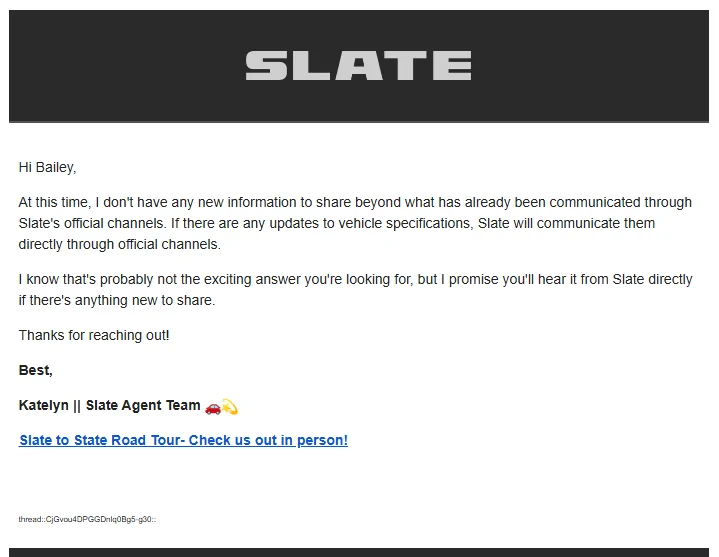
just got the email back about that article saying the battery would be LFP slate basically says we can not confirm or deny it because slate official hasn't said anything so that seems to be the go to answer tell the 24th I'm betting lol they have become very very tight lipped since the start of this month but in not saying no its NCM like before not saying anything is the key to say something has definitely changed because before they would say yes it is NMC from skON
Slate Auto Pickup Truck Small battery Slate (150 mi) has better driving dynamics? {0B4BEC9E-15B5-4615-A7B9-8D3F37026E68}
 

1yeliab_sufur1

Well-Known Member
Joined
May 20, 2025
Threads
69
Messages
878
Reaction score
912
Location
phoenix
Vehicles
king ranch F-150
my question why even go NMC vs LFP it seems a no brainer to switch to LFP longer cycle life and 0 to 100 charging vs 20-80 it may not be as energy dense but for longevity just seems a better option but i don't know all about battery's
 

metroshot

Well-Known Member
First Name
Pat
Joined
Apr 30, 2025
Threads
8
Messages
453
Reaction score
508
Location
CA
Website
www.kudo-ume-farms.com
Vehicles
Mach E + Honda PHEV
my question why even go NMC vs LFP it seems a no brainer to switch to LFP longer cycle life and 0 to 100 charging vs 20-80 it may not be as energy dense but for longevity just seems a better option but i don't know all about battery's
I agree with you.

LFP seems like the best for the standard range battery just like the newer Ford Mach E.
NMC is being used in the extended range battery in the Ford Mach E.

I think LFP have a different energy curve in colder temps.

Since I am in hot sunny So Calif weather, I'd love LFP.
 
OP
OP
Mike

Mike

Member
Joined
May 7, 2026
Threads
1
Messages
17
Reaction score
31
Location
Florida
Vehicles
GR86 Anniversary Edition, Chevy Traverse Z71
my question why even go NMC vs LFP it seems a no brainer to switch to LFP longer cycle life and 0 to 100 charging vs 20-80 it may not be as energy dense but for longevity just seems a better option but i don't know all about battery's
I think it was for the EV credit, as a the time SK On only manufactured NMC in the USA, I'm not sure thought.

NMC is better for colder climates, performance and energy density. I think it would be cool if they use LFP for the standard range and NMC for the long range/colder climates (energy density).
 

KevinRS

Well-Known Member
First Name
Kevin
Joined
Jul 4, 2025
Threads
6
Messages
1,641
Reaction score
1,915
Location
California
Vehicles
Nissan Versa
NMC energy density is part of it. For extended range, just guessing, but if they could only get 200 miles instead of 240, would you still say they should go LFP for both?
Quick search is indicating it might be worse than that. Numbers I'm seeing would indicate that in the weight of an NMC extended, same weight would be pretty close to standard range with LFP.
So going pure LFP there basically wouldn't be an extended option at all.
 

2thlesswithta2s

Active Member
First Name
Ron
Joined
May 17, 2026
Threads
1
Messages
44
Reaction score
50
Location
NY
Vehicles
Subaru Toyota
Being I studied manufacturing engineering as my college degree, I was a member of the student branch of the Society of Automotive/Aerospace Engineers. I've been a car geek since I was a kid. I've been interested in and studied how automobiles are designed and manufactured. I learned well before the internet was a thing that cars are basically comprised of 30,000 to 40,000 individual parts, which includes electronic circuit board components, fasteners, ball bearings, bearing races, engine internals, etc. - you get the point. So, when a year ago CEO Barman said the same thing, that the Slate is manufactured with less than (just) 800 parts vs. the typical pickup truck of 3,000 to 4,000, my ears really perked up. I don't believe it. Maybe there are 800 SKU assemblies tracked on the production line that make up the final assembly, but still I even don't believe that.
I've been an industrial/manufacturing/supply chain engineer for almost 40 years. I hear what you're saying about exploded part count & LRP, but Slate's plant is a primary assembly operation with mostly purchased sub-assemblies. The only thing they're fabricating in-house is the frame. Most typical auto manufacturing plants do more in-house fabrication because of the model variations, trim levels, & options they support.

Take the wiring harness for example. In my Subaru I had to look up what trim level it had so I could find the correct fuse-block layout. There were 3 different layouts in a single model year, & you can bet each one of them had a unique wiring harness. Most likely they fabricated the harnesses in-house so they could run a lean inventory of assembly-ready WIP harnesses according to the product mix of trim levels in the production orders on a given day. The product mix varies to replenish inventory of whatever customers are buying, so they have to react quickly.

Slate, on the other hand, has one trim level & can run a lean assembly operation with purchased pre-assembled wiring harnesses of a single design. So in that case, their BOM has a single wiring harness SKU. And it's a simpler wiring harness at that.

Compare that to the typical automotive wiring harness fabricated in-house & the BOM includes a SKU for every wire, connector, junction-block, hanger, & jacket.

Then there's the ICE power train. Even if you count the engine & transmission as only 2 SKU's, there are engine mounts, cooling, fuel delivery, exhaust, intake, alternator, & starter systems just to name a few. These are likely purchased SKU's, but if there are 2 or 3 engine choices to go with the various trim levels, you multiply the SKU's in inventory all the same.
 

E90400K

Well-Known Member
First Name
Francis
Joined
Apr 26, 2025
Threads
9
Messages
1,597
Reaction score
1,654
Location
Under a Bridge in the Middle of the Mid Atlantic
Vehicles
A Ford truck
I've been an industrial/manufacturing/supply chain engineer for almost 40 years. I hear what you're saying about exploded part count & LRP, but Slate's plant is a primary assembly operation with mostly purchased sub-assemblies. The only thing they're fabricating in-house is the frame. Most typical auto manufacturing plants do more in-house fabrication because of the model variations, trim levels, & options they support. Yup, the ICE has an exhaust system maybe 16 parts to assemble. Slate is making it's own seats and HV battery.

Take the wiring harness for example. In my Subaru I had to look up what trim level it had so I could find the correct fuse-block layout. There were 3 different layouts in a single model year, & you can bet each one of them had a unique wiring harness. Most likely they fabricated the harnesses in-house so they could run a lean inventory of assembly-ready WIP harnesses according to the product mix of trim levels in the production orders on a given day. The product mix varies to replenish inventory of whatever customers are buying, so they have to react quickly.

Slate, on the other hand, has one trim level & can run a lean assembly operation with purchased pre-assembled wiring harnesses of a single design. So in that case, their BOM has a single wiring harness SKU. And it's a simpler wiring harness at that.

Compare that to the typical automotive wiring harness fabricated in-house & the BOM includes a SKU for every wire, connector, junction-block, hanger, & jacket.

Then there's the ICE power train. Even if you count the engine & transmission as only 2 SKU's, there are engine mounts, cooling, fuel delivery, exhaust, intake, alternator, & starter systems just to name a few. These are likely purchased SKU's, but if there are 2 or 3 engine choices to go with the various trim levels, you multiply the SKU's in inventory all the same.
I don't want to debate this too much. But Slate is saying their final assembly is a 800 line item manufacturing bill of material. Fine, so they build with a lot of subassemblies from suppliers. So a 800 MBOM vs. 4,000 MBOM, doesn't mean 80% less parts. Granted an ICE drivetrain has more more parts on the MBOM. Fuel delivery hoses and fuel tank, but the EV has electric transmission lines, charging lines and plug, and a battery. Cooling, yes ICEV has cooling but so does an EV and probably more plumbing and pumps than ICE. The engine as a MBOM line item comes fully assembled with alternator, AC compressor, intake and exhaust manifolds. Engine mounts? Yes, but an EV has electric motor mounts.

While Slate's MBOM may be 800 line items, the suppliers have to build the individual parts into subassemblies. There is cost in the total manufacturing effort, whether it's in Warsaw or at a supplier in Michigan, or Georga, or Ohio. I do not think the Slate is built with only 20% of the parts that say, a Ford Ranger is built with. I just don't think it is physically possible.

Slate is building the seats and battery in Warsaw.
 
Last edited:

Driven5

Well-Known Member
Joined
Jul 8, 2025
Threads
2
Messages
325
Reaction score
589
Location
WA
Vehicles
F150
Meanwhile, back at the ranch...

I've been wondering, since all Slate Trucks are the same off the assembly line (motor and all), wouldn't that mean that the smaller battery one is lighter? Meaning faster, better handling, and more fun to drive. I'm no engineer, so I have no idea, but it makes sense to me.
Intuitively, that was my thought at first too... But the more time I've had to think about it, the less conclusive the answer has become.

If all else is equal, lighter is better... But all else is not equal.

Without getting into some the boring technical explanations, the lighter weight of the small pack vs lower center of gravity of the large pack results in each option being slightly better than the other in some ways, but slightly worse in others. So there really is no easy answer to which will be better handling and more fun to drive, at least not until there is public testing... And possibly not even then.

Having more battery modules also generally means higher voltage though. Higher voltage generally means more potential rated power... This could easily result in the large pack being more powerful (and faster) than the small pack, and is one plausible explanation for their website glitch showing 185hp vs the long claimed 200hp.
 
Last edited:
 
Top