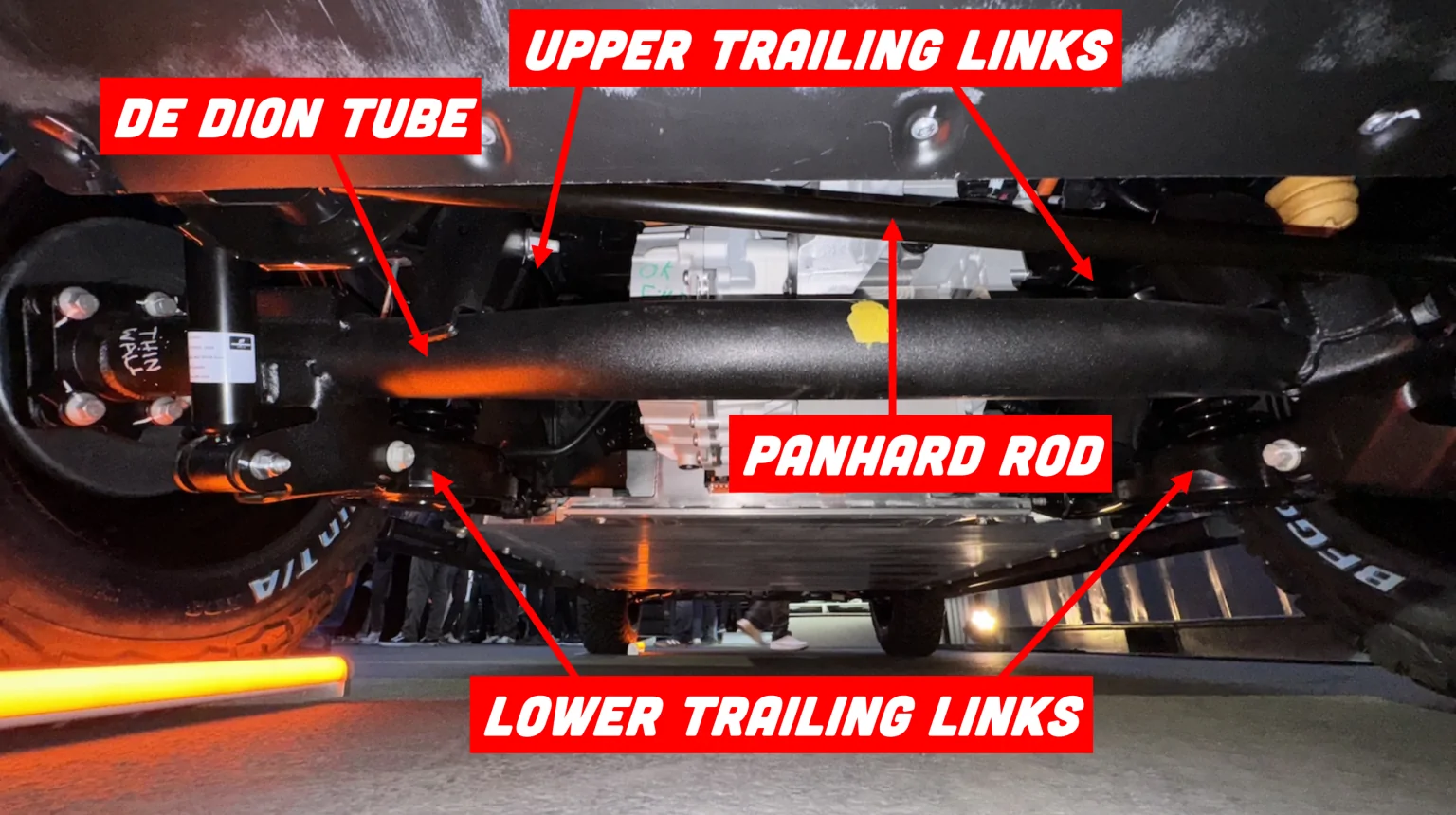
That image is also from shortly after the reveal in early 2025, very prototype. I wouldn't assume that the suspension will end up being exactly the same by production.
I would love to see an engineering analysis of Slate’s suspension conducted by Sandy Munro’s team. Here is an in depth hoist review of the suspension on the Chevy Blazer EV.
If the Slate ends up popular with people that care that much about how it handles (I still think an SCCA autox Spec Slate class would be a fun idea, even though that's not really what I'm looking for), then some real suspension pervert will design a watts link for it (maybe me, lol).
Spec Slate would be awesome, even if it doesn't make any logical sense.
The problem with Watts link is that it's a lot of complication and expense for no real benefit. From a performance perspective, a credit card (or even USB charging cable) worth of lateral movement that doesn't actually affect the alignment or contact patch is lost in the noise of other compliance and deflection from the tires and suspension. A few things people also tend to either not know or neglect when discussing the virtues of the symmetry of Watts for 'turning both directions' are that:
1) L/R handling is already imbalanced on cars with equal L/R spring rates but unequal L/R weight distribution. This is why so many people have experienced faster lap times with a passenger on board than solo, despite the extra weight.
2) Every autox/road course still has 360 degrees more turns one direction than the other. So equal L/R cornering is not necessarily fastest overall.
3) Not applicable to the Slate DeDion, but on live axles some Panhard angle can also be used to help counter the unbalanced torque effects.
Not that it's often done, or even thought about, but an adjustable AND reversible Panhard would actually be more 'ideally' tunable (and easily so) to any given track than a Watts.
Assuming a lowered Slate effectively levels out the Panhard, my biggest gripe with the it is just that it would be better to run the bar the opposite (axle left, chassis right) way... Such that the roll center rises when the body rolls towards the driver side and the roll center lowers when the body rolls towards the passenger side. This would counter rather than contribute to the imbalanced L/R roll effects. As well thought out as the rest of the Slate DeDion setup seems to be, I'm guessing there were other packaging constraints that took precedence instead.
That's what I'm figuring. I figure the factory drop will improve that angle some and I'd honestly be OK with an aftermarket kit that levels the panhard bar and corrects for the slightly shorter distance
There is added weight for sure, but depending on goals, it would be worth it. The watts linkage would have better handling consistency, especially if performance is the goal. For daily driving, it likely wouldn't be a noticeable difference over a well setup panhard bar.
...And unsprung weight at that. But in all fairness, my previous comments were also from more of a theoretical standpoint.
As with almost everything, the answer to which is better in practice is 'it depends'. Each has its potential advantages in different circumstances. and execution matters more than anything. There are many people who have found improvements going from Panhard to Watts, but it generally seems to be non-optimized Panhard to optimized Watts. I've not seen any of those that have demonstrated true apples-apples comparisons between equally well engineered solutions.
Personally if I was going through the cost and effort to add the complexity of a Watts, I'd probably take it all the way to a Mumford instead.
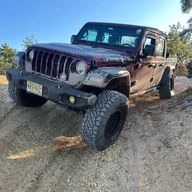
It’s not great for sure, but also this has the KO2s on, so this is the 2” lift, I suspect stock height will be basically flat, this is still less of angle on the 2” lift on JL/JTs and they perform just fine.