
What limits the Slate to 1000 pounds towing capacity?

AZFox

Well-Known Member
Joined
Apr 29, 2025
Threads
39
Messages
1,510
Reaction score
2,118
Location
Arizona
Vehicles
Honda NC700X
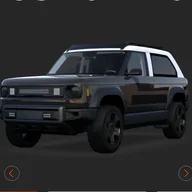
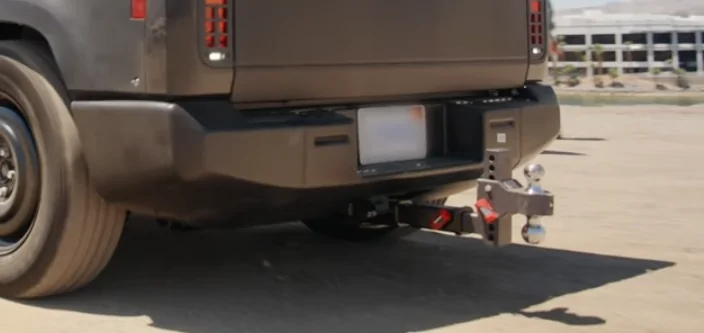
That is a step bumper. Trailer ball bolts through hole in the horizontal surface below the license plate. Every truck I have owned has had a very similar bumper with holes in it to mount the trailer ball. It is only rated at 1000 pounds, the step bumper is good for it.
I've towed with a hitch ball mounted on a bumper since several decades ago, so I know how that works.

That's why I can look at the bumpers we've seen so far and tell they weren't designed to accept a hitch ball and safety chains.

Slate's design philosophy is to leave out what isn't necessary.
It's not necessary for the stock bumper to have towing capability.
Slate will offer a Hitch Receiver accessory for towing.
 

KevinRS

Well-Known Member
First Name
Kevin
Joined
Jul 4, 2025
Threads
3
Messages
803
Reaction score
996
Location
California
Vehicles
Nissan Versa
Slate's design philosophy is to leave out what isn't necessary.
It's not necessary for the stock bumper to have towing capability.
Slate will offer a Hitch Receiver accessory for towing.

Part of what is confusing on it is the standard bumper looks like a step bumper, which would have holes or knockouts for a hitch ball and for chains to hook, which would probably be the cheapest possible option, and fits with the stated tow rating.
Then the upgraded bumper is definitely not a step bumper, more of a box bumper, with the license plate right where a hitch might go, and a shallow sloped plastic underside with no frame or other metal visible where an accessory would mount.
It's got to be something that just wasn't designed yet when they built the prototypes we've seen, probably 5 or more months ago.
 

AZFox

Well-Known Member
Joined
Apr 29, 2025
Threads
39
Messages
1,510
Reaction score
2,118
Location
Arizona
Vehicles
Honda NC700X
Part of what is confusing on it is the standard bumper looks like a step bumper, which would have holes or knockouts for a hitch ball and for chains to hook, which would probably be the cheapest possible option, and fits with the stated tow rating.
It would be cost less to make it not capable and require the Hitch Receiver option if you want to tow.

I'm assuming a more capable bumper costs more to make, which is a pretty safe assumption.
 

KevinRS

Well-Known Member
First Name
Kevin
Joined
Jul 4, 2025
Threads
3
Messages
803
Reaction score
996
Location
California
Vehicles
Nissan Versa
It all depends on the decisions they made, and we probably won't know any more until they make another round of announcements, maybe in October when they start the tour back up.
 

Daemoch

Well-Known Member
First Name
Ugle
Joined
Jun 26, 2025
Threads
5
Messages
173
Reaction score
195
Location
Wisconsin
Vehicles
Lots. Just....lots.
I suspect the extension is just because that particular hitch wasnt long enough. hitches themselves do come in various arm lengths technically. Were all just used to seeing the short arm ones for big trucks with very exposed receivers.

Ive got an extension I can use if I need to but it cuts the total load ability in half. If I plan ahead I just use a longer armed hitch and then I have full load capability.
 

E90400K

Well-Known Member
First Name
Francis
Joined
Apr 26, 2025
Threads
5
Messages
582
Reaction score
426
Location
Under a Bridge in the Middle of the Mid Atlantic
Vehicles
A Ford truck
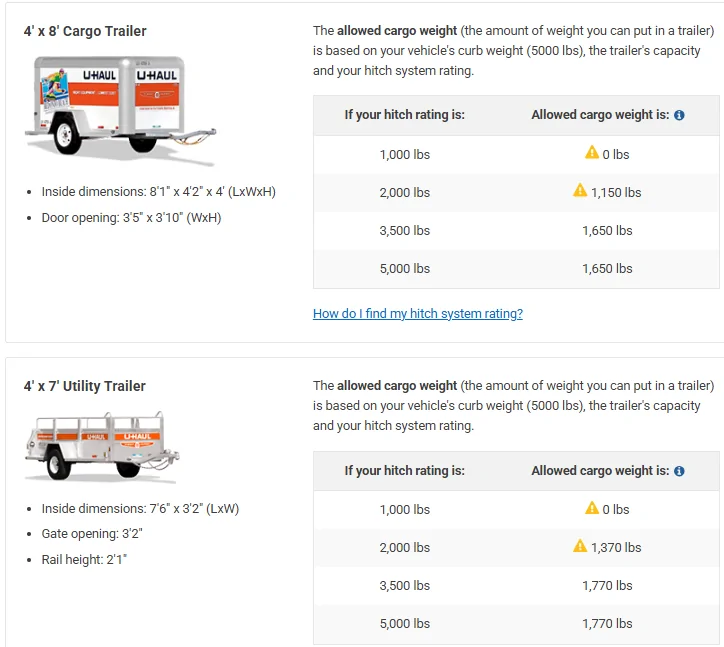
So... today I was looking up the price to rent a motorcycle trailer from U-Haul. I noticed that even their smallest box trailer and utility trailers are over 1,000 pounds minimum tow rating. This might be problematic for Slate.

Slate Auto Pickup Truck What limits the Slate to 1000 pounds towing capacity? Screenshot 2025-12-20 183354
 

KevinRS

Well-Known Member
First Name
Kevin
Joined
Jul 4, 2025
Threads
3
Messages
803
Reaction score
996
Location
California
Vehicles
Nissan Versa
So... today I was looking up the price to rent a motorcycle trailer from U-Haul. I noticed that even their smallest box trailer and utility trailers are over 1,000 pounds minimum tow rating. This might be problematic for Slate.

Screenshot 2025-12-20 183354.webp
I don't know how they are calculating this. Empty that 2nd trailer is 630 lbs, I'm not finding the page you screenshot to see what the hazard icons are for.
630 lbs still doesn't leave a lot of room for load, you've only got 330 lbs left from how I calculate it.
 

Johnologue

Well-Known Member
First Name
John
Joined
Dec 14, 2025
Threads
0
Messages
62
Reaction score
79
Location
WA, USA
Vehicles
2017 Hyundai Veloster
Does it matter that the Slate Truck has a "50/50" weight distribution, as was mentioned on the recent Q&A summary?

I don't know about trucks/towing, but I realized that might be a limiting factor in how much weight can be added to the rear of the vehicle, and something that wouldn't come up on most front-heavy ICEVs, or the other overall-heavy EV trucks (it seems everything else is at least around 6000 lbs).

50% of 3600 would be 1800 lbs on each axle, so putting ~1000 lbs toward the rear might be relatively challenging. Or would that not matter?
 

KevinRS

Well-Known Member
First Name
Kevin
Joined
Jul 4, 2025
Threads
3
Messages
803
Reaction score
996
Location
California
Vehicles
Nissan Versa
Does it matter that the Slate Truck has a "50/50" weight distribution, as was mentioned on the recent Q&A summary?

I don't know about trucks/towing, but I realized that might be a limiting factor in how much weight can be added to the rear of the vehicle, and something that wouldn't come up on most front-heavy ICEVs, or the other overall-heavy EV trucks (it seems everything else is at least around 6000 lbs).

50% of 3600 would be 1800 lbs on each axle, so putting ~1000 lbs toward the rear might be relatively challenging. Or would that not matter?
Pretty sure that is part of why it is only 1400 lbs payload and 1000 towing. Since it's kind of hard to load with more than that in total between driver, passenger, frunk load and bed load without putting too much on the rear axles and not enough on the front - steering axles, they set that as the target and engineered for it. At that, the wheels are about as far to the front and rear as they reasonably can, unlike many which put the rear axle mid-bed or even further forward, which works with a heavy engine at the front, 4 people, and a load, but means a full load mostly in the bed is still unbalanced.
 

Tom Sawyer

Well-Known Member
Joined
Jan 11, 2026
Threads
0
Messages
64
Reaction score
49
Location
Northeast Ohio
Vehicles
CJ-7
Current guidance on towing from Slate.

SLATE.AUTO said:
HOW MUCH CAN A SLATE HAUL?
The Slate truck is rear-wheel drive and projected to have around a 1,400-lb payload and 1,000-lb towing capacity. But with EVs, towing isn’t just about numbers on a spec sheet — it’s about how electric power delivery, battery management, and vehicle architecture change the experience compared to traditional gas trucks.

TOWING: EV VS. GAS ENGINE
Gas trucks rely on combustion engines that hit peak power higher in the RPM range. EVs are different — they deliver max torque instantly. That means pulling a trailer with Slate will feel stronger off the line than a similar-spec gas-powered vehicle, even if the tow rating is modest.

But EV towing has a few unique considerations:

1. BATTERY SIZE AND RANGE

Towing pulls more energy from the battery — just like it burns more fuel in a gas truck. Depending on trailer weight, shape, and speed, range can decrease because the vehicle is pushing more drag and weight.

  • Heavier loads = more energy consumption
  • High speeds increase aerodynamic drag
  • Hills and elevation changes draw more power

The Slate is designed for real-world use cases and daily utility, so its towing capacity is tuned around preserving range and ensuring predictable performance.

2. MOTOR AND DRIVETRAIN
Because the Slate is rear-wheel drive, its tow rating is optimized around traction, stability, and thermal limits. EV motors generate torque instantly, which is great for pulling — but sustained towing creates heat, and EVs need to protect motors, inverters, and battery systems from overload.

3. REGENERATIVE BREAKING [sic]
One of the biggest advantages of EV towing is regen braking. With a load behind you:

  • The motor can recapture more energy going downhill
  • Braking distances can feel more controlled
  • You reduce wear on physical brakes

But regen has limits at higher speeds or with very heavy loads, which is why total tow capacity is carefully balanced.

4. WEIGHT DISTRIBUTION AND HITCH DYNAMICS
EVs carry more weight low in the chassis thanks to the battery pack. That helps stability, but tongue weight, trailer sway, and hitch setup still matter just like in any gas truck.

SO…WHAT CAN SLATE REALLY HANDLE?

For small trailers, motorcycles, yard equipment, kayaks, camping setups, and weekend utility jobs — the Slate truck's projected 1,000-lb tow rating and 1,400-lb payload should be plenty. And the instant torque makes low-speed hauling (like backing a trailer into a tight spot) easier than with a gas engine. A Slate isn’t meant to replace a full-size tow rig, though. It’s built for everyday practicality, not heavy-duty hauling.
1. It'll be interesting to see if this guidance changes over time.
2. I'm surprised Slate spelled the word 'braking' as 'breaking'

I don't see anything new here, just that it's a section/page of its own on the Slate.auto website.
 
 
Top