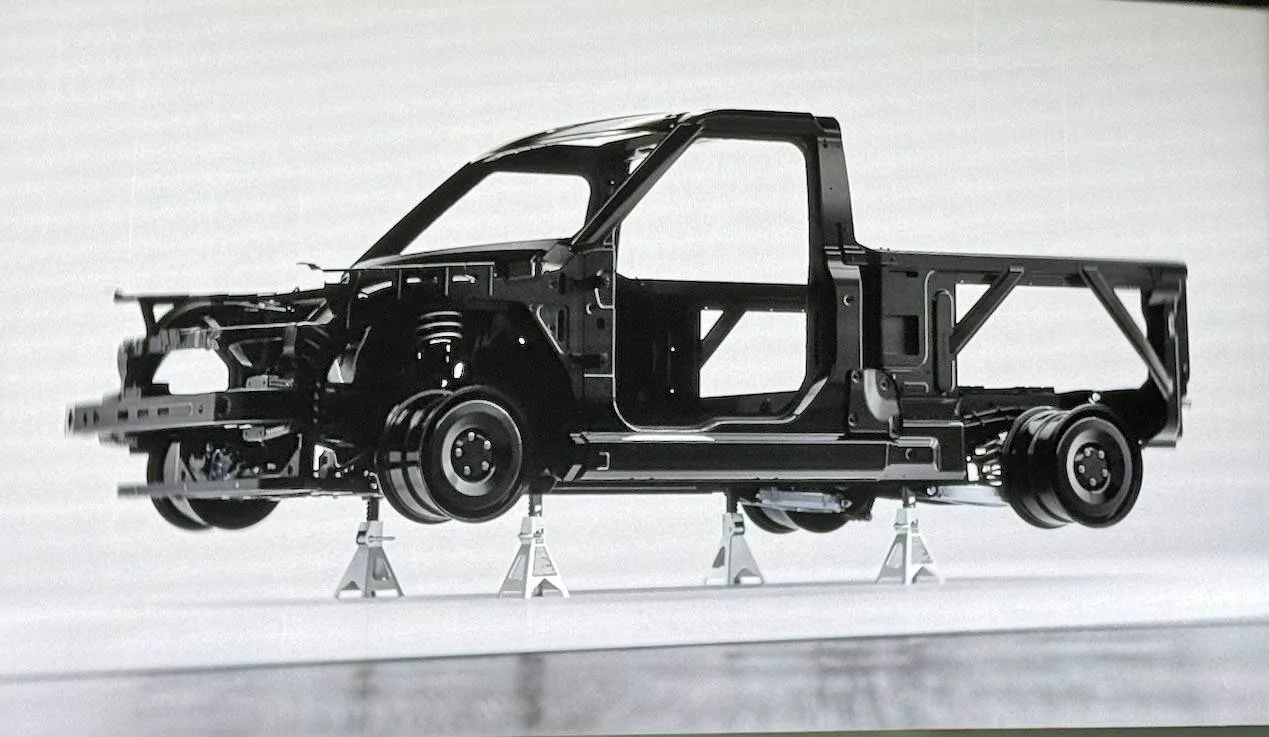
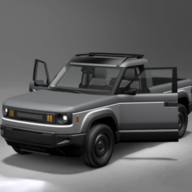
At least this can be shown to those people that think more than 2 doors is necessary:
Rod Copes -- "Should the second model have 4 doors? ... We package protected for four doors."
AI summary (for those who prefer to read):
In this episode of the MotoManTV Podcast, host MotoMan interviews Rod Copes—Board Director and Employee #1 at Slate Auto—to discuss the company’s mission to launch a truly affordable $24,950 electric pickup truck built in the United States.
Key Takeaways & Discussion Highlights
1. Rod Copes’ Background & Founding Team [02:46]
Automotive & Motorcycle Veteran: Copes spent 20 years at Harley-Davidson (focusing on vehicle customization), 5 years re-establishing Royal Enfield in the US (growing sales from a few hundred to ~20,000 units/year), and nearly 2 years as Rivian’s first Chief Operating Officer (COO) during its initial scaling phase.
The MIT Connection [05:18]: Slate originated out of relationships formed at MIT's Leaders for Manufacturing program. Key founders include Jeff Wilke (former Amazon CEO of Worldwide Consumer under Jeff Bezos) and Miles Arnon (founder of private equity firm Rebuild Manufacturing).
Backing: Spun off from parent company Rebuild Manufacturing in early 2023, receiving early seed backing from Jeff Bezos directly [19:34].
2. Slate’s Core Philosophy: "Ruthless Simplicity" [16:40]
To avoid the financial pitfalls of previous EV startups, Slate adheres to a strict design and production mandate:
Drastically Fewer Parts [17:04]: The Slate truck uses approximately 600 parts, compared to ~2,500 parts in a standard EV like the Rivian R1T.
Capital-Light Manufacturing [17:12]: Eliminates expensive infrastructure like traditional paint shops and complex metal stamping presses.
Single Iteration Loops [18:13]: Instead of running 2–3 design validation build cycles, engineers get only one iteration supported by advanced computer modeling and simulation.
Amazon Corporate Culture [20:34]: Adopts Amazon's 6-page narrative document process instead of PowerPoint presentations to force rigorous problem-solving before executing decisions.
Lessons from Rivian [25:05]: Copes describes "production hell" as facing more simultaneous problems than a team can handle for up to a year. At Rivian, launching three vehicles on two assembly lines while scaling from 1,500 to 10,000 employees created extreme friction.
Disciplined Capital Use [32:01]: Slate plans to raise ~$1.5 billion total to reach profitability—a fraction of the $25B+ spent by Rivian or $35B+ spent by Tesla.
Target Launch [14:42]: Target production is scheduled for Q4 2026 at a brownfield manufacturing plant in Indiana [57:39].
Fixed $24,950 Price Point [34:25]: Unlike competitors that advertise low base prices with unavailable baseline trims (e.g., Ford Maverick), Slate aims for a fixed single price point with transparent destination fees.
Accessible Overnight Charging [43:35]: Designed so owners without dedicated garage space or Level 2 chargers can replenish 35–40 miles of daily range overnight using a standard 110V household outlet.
2-Door Design Decision [45:01]: The 2-door configuration was chosen purely to lock in the sub-$25k price floor, though a 4-door platform is package-protected for future vehicle models [47:00].
Updated Battery Range [54:55]: Pivoted to a cell-to-pack strategy with an established supplier to deliver over 200 miles of range.
I don’t think it’s ever smart to talk about future models, especially before releasing the current one. Slate is going to Osborne itself somewhat due to this.
I believe it means that the current design can be altered with little modifications to the rest of the design.
An example would be adding 12in into the middle without having to increase structure elsewhere.
Or being able to add a front motor without having to design a new front suspension.
I don’t think it’s ever smart to talk about future models, especially before releasing the current one. Slate is going to Osborne itself somewhat due to this.
I think if the 2 door doesn't fill capacity they will probably pivot quickly to the four door. As long as they have some sales they should have enough cash flow to make the modifications and they could even be built on the same line, other manufacturers do similar things.
I think if the 2 door doesn't fill capacity they will probably pivot quickly to the four door. As long as they have some sales they should have enough cash flow to make the modifications and they could even be built on the same line, other manufacturers do similar things.
Auto line after Hours Podcast #799 also mentioned that slate is planning on 4 doors (36min mark I believe) though Slate is understandingly being quiet about this- don’t want to affect sales of the 2 door
Figuring out where to put all the components of all the vehicle systems is "packaging". Package protect means defining "keep-out" areas where none of those components may be located. In this case, those keep-outs are the areas of the chassis that would have to be removed to create two more door openings. Basically, it means you could design a 4-door body that would take all the same non-body parts in the same locations.
Figuring out where to put all the components of all the vehicle systems is "packaging". Package protect means defining "keep-out" areas where none of those components may be located. In this case, those keep-outs are the areas of the chassis that would have to be removed to create two more door openings. Basically, it means you could design a 4-door body that would take all the same non-body parts in the same locations.
i seem to recall Eric Keipper using that same "package protect" phrase when talking about the frunk space in one of the recent price reveal event videos.
In a strange twist today, my wife said she wanted a puppy! I said, “absolutely not - we have 2 dogs already and adding a third would be irresponsible…”. Then realizing the logical trap she had laid, I said, “you would have to take care of it and we would name it, “Slate”!”
i seem to recall Eric Keipper using that same "package protect" phrase when talking about the frunk space in one of the recent price reveal event videos.
He did. I remember as well. I took his statement to mean the body in white was designed from the get go to be a 4-door with respect to passenger crash protection.
Ah, yeah. I see what you mean. The bed of the truck interferes with that.
Slate might have also realized, like Rivian, that most US customers want an electric SUV over an electric truck (or in Slate’s case a 4-door vehicle over a 2-door vehicle). It’s a more lucrative market. The problem is getting the expense down.
I personally think Slate should have razor-thin margins or break even on the base model and then make all of their profit on kits and accessories. A more affordable price point would activate customization sooner. I guess we’ll find out next year. I’m excited to see them on the road.
Wait, the chassis was designed to allow a four-door variant, like sticking an extra slice of cab in the middle?
Dammit. I need to check this and change some notes.