
Articles and Videos of Interest That Don't Merit Their Own Threads

E90400K

Well-Known Member
First Name
Francis
Joined
Apr 26, 2025
Threads
5
Messages
636
Reaction score
485
Location
Under a Bridge in the Middle of the Mid Atlantic
Vehicles
A Ford truck
This video has a more detailed explanation:

Three years ago, the global auto industry was gripped by a collective hallucination. CEOs promised us that the internal combustion engine would be dead by 2035 and that legacy automakers were just one battery factory away from a trillion-dollar valuation.
That narrative has now collided with economic reality.
In this video, we analyze the collapse of the "inevitability" narrative. We look at why Ford has been forced to take a staggering $19.5 billion write-down, why the European Union is quietly dismantling its own petrol ban, and why—despite billions in subsidies—automakers are still losing $6,000 on every electric vehicle they sell.
We examine how the industry confused a political project with consumer demand, leading to a market where the cars are too expensive for the middle class and too unprofitable for the manufacturers.


It was posted in December, before GM announced their second write-down in January.

Eventually car makers will make economical EVs people actually want to buy.

Slate Auto is ahead of the curve.
The bolded text is where your economic theory fails. I do not think EV can be profitably manufactured at competitive prices (vs. ICEV) because the battery cost is too high. Look what Slate has to do to try and be on par with ICEV. They have to go into a market segment that really doesn't exist, and strip their Truck of nearly all amenities, including paint, to build it under a single model/trim single-color form. And they have to use a service network where they have no control over the quality and cost of the service/warranty repair work. Worst, they think they will rely on owners to perform DIY warranty repair?

Maybe it works for 150,000 unit sales early on, but how about for 10 years or 20 years? Hopefully it works.
 
Last edited:

OP
OP
AZFox

AZFox

Well-Known Member
Joined
Apr 29, 2025
Threads
40
Messages
1,637
Reaction score
2,284
Location
Arizona
Vehicles
Honda NC700X
The bolded text is where your economic theory fails. I do not think EV can be profitably manufactured at competitive prices (vs. ICEV) because the battery cost is too high.
This is a misconception.

You seem to jump at every opportunity to emphasize what could be problematic about EVs versus ICEVs in general, and the Slate in particular.

Affordable cars in general and affordable EVs in particular haven't been offered for reasons other than whether people would buy them and whether manufacturers could profit from them if they were.

Ford, GM, and Stellantis have charged of monumental (10s of $billions!) because they produces EVs that are expensive, hi-tech monstrosities instead of producing practical, economical vehicles, which would have been entirely possible for them to do.

Edit: IMHO battery technology will improve. When it does, a tipping point will be reached and affordable EVs will proliferate. Slate Automotive is positioning themselves ahead of that curve.

Edit: This quote from the video offers some insight:

Trucks and SUVs now make up 80 percent of new vehicle sales. For decades, this preference was a goldmine for Detroit.​
In the internal combustion era, the manufacturing math was compelling: big cars cost only marginally more to stamp out than small cars, but they could be sold for significantly higher prices.​
As Ford CEO Jim Farley explained, in the gas-powered world, "the bigger the vehicle, the higher the margin".​
Electrification inverts this logic. In the EV world, the bigger the vehicle, the bigger the battery you need to move it. Since the battery is the single most expensive component, scaling up doesn't increase your margin; it destroys it.​
 
Last edited:

E90400K

Well-Known Member
First Name
Francis
Joined
Apr 26, 2025
Threads
5
Messages
636
Reaction score
485
Location
Under a Bridge in the Middle of the Mid Atlantic
Vehicles
A Ford truck
This is a misconception.

You seem to jump at every opportunity to emphasize what could be problematic about EVs versus ICEVs in general, and the Slate in particular.

Affordable cars in general and affordable EVs in particular haven't been offered for reasons other than whether people would buy them and whether manufacturers could profit from them if they were.

Ford, GM, and Stellantis have charged of monumental (10s of $billions!) because they produces EVs that are expensive, hi-tech monstrosities instead of producing practical, economical vehicles, which would have been entirely possible for them to do.

Edit: IMHO battery technology will improve. When it does, a tipping point will be reached and affordable EVs will proliferate. Slate Automotive is positioning themselves ahead of that curve.

Edit: This quote from the video offers some insight:

Trucks and SUVs now make up 80 percent of new vehicle sales. For decades, this preference was a goldmine for Detroit.​
In the internal combustion era, the manufacturing math was compelling: big cars cost only marginally more to stamp out than small cars, but they could be sold for significantly higher prices.​
As Ford CEO Jim Farley explained, in the gas-powered world, "the bigger the vehicle, the higher the margin".​
Electrification inverts this logic. In the EV world, the bigger the vehicle, the bigger the battery you need to move it. Since the battery is the single most expensive component, scaling up doesn't increase your margin; it destroys it.​
I just disagree with you. There are plenty of affordable cars. How can one not think a $30K lower trim model of the Camry is not affordable? Likewise the Accord. Likewise the CX-5, or CR-V?

Are you trying to equate a $35K compact or $45K mid-size electic SUV as not affordable and the tiny, 2-door $27.5K Slate as offering the same capability at half the price? Come on now, the Slate has manual rollup windows, no electric mirrors, and needs to be rewrapped every 3 years (per Barman's own comments).

The US market is still transacting at 15M to 17M new vehicles sales each year. Its not all that bad. If a person has a $30K budget for a new car purchase there are many models available in that price range.

Your Farley comment, "Electrification inverts this logic. In the EV world, the bigger the vehicle, the bigger the battery you need to move it. Since the battery is the single most expensive component, scaling up doesn't increase your margin; it destroys it." Exactly makes my case. EVs can't be sold at a profit.
 
OP
OP
AZFox

AZFox

Well-Known Member
Joined
Apr 29, 2025
Threads
40
Messages
1,637
Reaction score
2,284
Location
Arizona
Vehicles
Honda NC700X
Your Farley comment, "Electrification inverts this logic. In the EV world, the bigger the vehicle, the bigger the battery you need to move it. Since the battery is the single most expensive component, scaling up doesn't increase your margin; it destroys it." Exactly makes my case. EVs can't be sold at a profit.
What he means by that is that scaled-up EVs aren't lucrative compared to scaled-up ICEVs, it turns out.

Slate's small-and-simple EV concept is something that's innovative and intentionally disruptive.

Can that work? I think so. We'll find out!

The whole existence of Slate arose because auto manufacturers shifted toward larger, more complex, more expensive vehicles for the affluent and away from affordable, entry-level models for people who can't afford those. If you don't like with that idea what you even doing here?
 

E90400K

Well-Known Member
First Name
Francis
Joined
Apr 26, 2025
Threads
5
Messages
636
Reaction score
485
Location
Under a Bridge in the Middle of the Mid Atlantic
Vehicles
A Ford truck
"Americans don't want small cars."

- US automakers in the late 70s just before Japanese automakers ate their lunch.
That statement has a whole geopolitical context to it that is not as simple as you think. And there were numerous models of domestic brand small cars in the market in the 1960's and 1970's. Gremlin, Vega, Pinto to name three.

And it was 1973, not the late 70's.
 

Tom Sawyer

Well-Known Member
Joined
Jan 11, 2026
Threads
0
Messages
94
Reaction score
72
Location
Northeast Ohio
Vehicles
CJ-7
But you remember these details because you were around at the time?? ;)
 

beatle

Well-Known Member
Joined
Jan 13, 2026
Threads
0
Messages
92
Reaction score
184
Location
Springfield, VA
Vehicles
'23 R1T, '97/25 Miatas, '19 Monkey
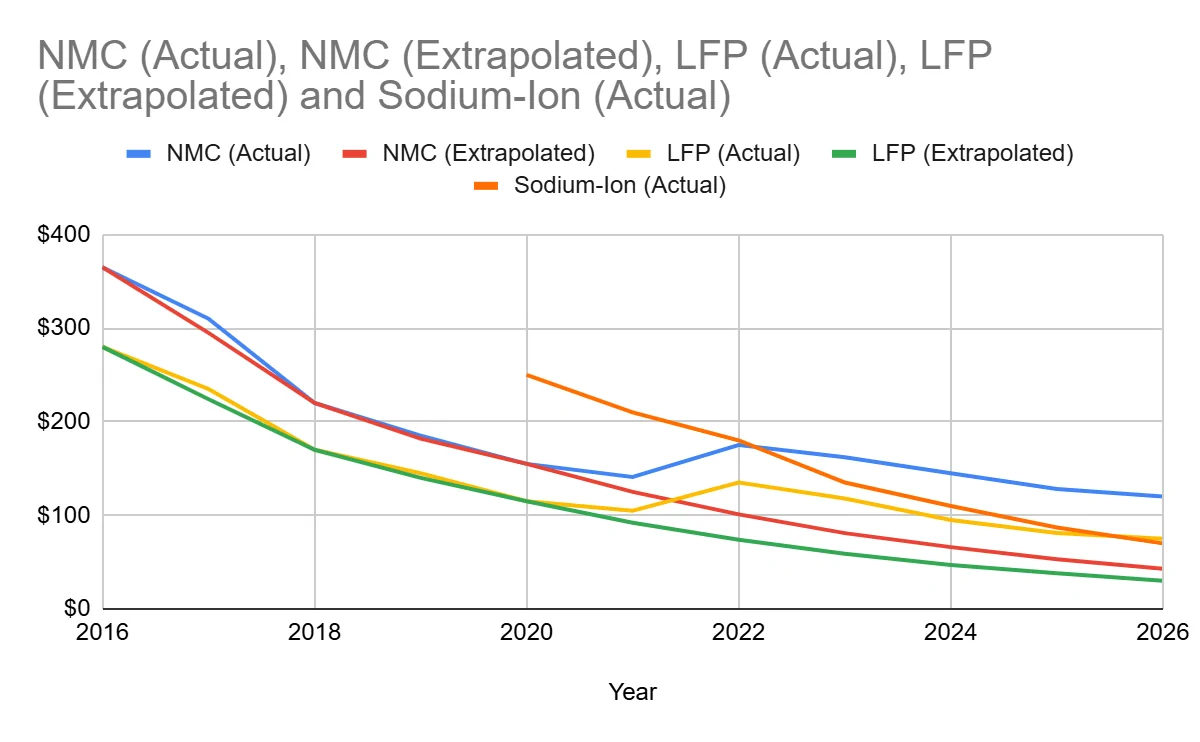
I don't think battery prices have dropped in price at the same rate that people thought they would back in the early 2020s. I created this graph to show the actual prices of the popular battery chemistries and what they'd be if they continued their downward trajectory at the same rate.

Slate Auto Pickup Truck Articles and Videos of Interest That Don't Merit Their Own Threads 1770742860974-h0


Back when EV investment was roaring, automakers jumped in, probably expecting battery prices to come down to a level that allowed them to be even cheaper than ICE. I still think they'll be cheaper, but we're not there yet.

While (most) Americans seem to love large vehicles, they also have range anxiety due to poor charging infrastructure and a lot of country that is largely only accessible by car. These drive the demand for vehicles with 300+ miles of range and without significantly improving charging infrastructure and speed, the only way to solve that is with more battery. And to fit "more battery" you unfortunately just need "more car."
 

E90400K

Well-Known Member
First Name
Francis
Joined
Apr 26, 2025
Threads
5
Messages
636
Reaction score
485
Location
Under a Bridge in the Middle of the Mid Atlantic
Vehicles
A Ford truck
But you remember these details because you were around at the time?? ;)
Noooooo.... :CWL:

And let's not get into the discussion about Ralph Nadar's attack on the Pinto (which BTW sold in greater numbers than the Mustang after MY 1972). If anyone in the US didn't want small cars it was Ralph Nadar, he sued the Big 3 at every chance he could over small cars. Never mind he completely ignored the poor safety performance of the 1970's Civic, Corolla, and B210, all worse than the domestic brands subcompact models. But I digress...
 
Last edited:

E90400K

Well-Known Member
First Name
Francis
Joined
Apr 26, 2025
Threads
5
Messages
636
Reaction score
485
Location
Under a Bridge in the Middle of the Mid Atlantic
Vehicles
A Ford truck
I don't think battery prices have dropped in price at the same rate that people thought they would back in the early 2020s. I created this graph to show the actual prices of the popular battery chemistries and what they'd be if they continued their downward trajectory at the same rate.

1770742860974-h0.webp


Back when EV investment was roaring, automakers jumped in, probably expecting battery prices to come down to a level that allowed them to be even cheaper than ICE. I still think they'll be cheaper, but we're not there yet.

While (most) Americans seem to love large vehicles, they also have range anxiety due to poor charging infrastructure and a lot of country that is largely only accessible by car. These drive the demand for vehicles with 300+ miles of range and without significantly improving charging infrastructure and speed, the only way to solve that is with more battery. And to fit "more battery" you unfortunately just need "more car."
Key design constraint... Well done for pointing this out.
 

beatle

Well-Known Member
Joined
Jan 13, 2026
Threads
0
Messages
92
Reaction score
184
Location
Springfield, VA
Vehicles
'23 R1T, '97/25 Miatas, '19 Monkey
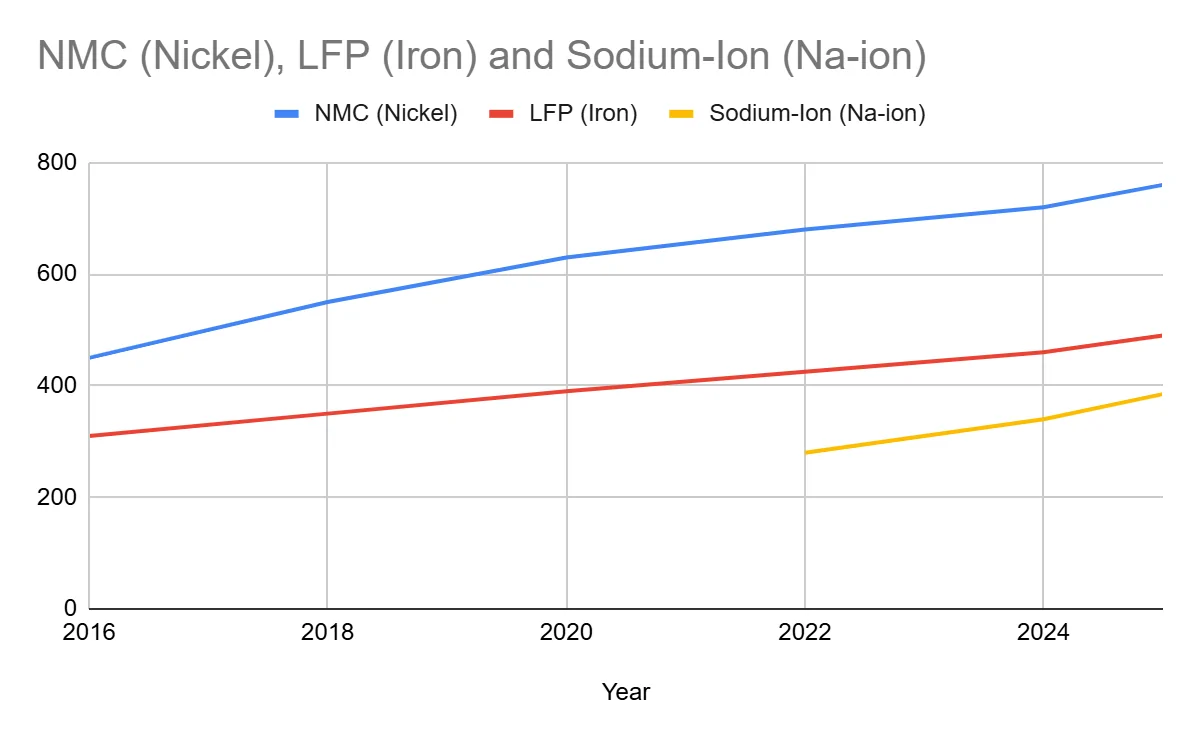
Another way would be "less weight per kWh", which I expect will happen.
Even more important than weight, IMO, is volumetric density which is usually measured in wh/li:

Slate Auto Pickup Truck Articles and Videos of Interest That Don't Merit Their Own Threads 1770748403927-l4


While weight isn't "free," it's more easy to compensate for with higher spring rates, slightly stronger frame, and a bit more power. It's very difficult to add more room for batteries, however, without making the vehicle bigger. While NMC batteries are lighter, they pack a lot more energy per unit of volume, and that means a more expensive chemistry is often needed to meet desired range targets just because it's not a matter of adding more LFP cells.
 
OP
OP
AZFox

AZFox

Well-Known Member
Joined
Apr 29, 2025
Threads
40
Messages
1,637
Reaction score
2,284
Location
Arizona
Vehicles
Honda NC700X
Suppose you have a nice SUV and That Friend Of Yours needs help moving over the weekend. Right now you have a great excuse… but with this revolutionary new idea from a car company called Slate, you could just… you know… CONVERT the SUV into a pickup and then back again. It’s quite a concept: and Scott Ott is a True Believer!

SLATE: One Size Doesn’t Fit All
 

cadblu

Well-Known Member
Joined
Apr 28, 2025
Threads
63
Messages
719
Reaction score
1,420
Location
New York
Vehicles
Tesla
Suppose you have a nice SUV and That Friend Of Yours needs help moving over the weekend. Right now you have a great excuse… but with this revolutionary new idea from a car company called Slate, you could just… you know… CONVERT the SUV into a pickup and then back again.
Well, to be honest he needs to be a “really good friend” for me to revert my Slate SUV back to a Day 1 pickup. In fact, I’d be willing to predict that mostly all owners who paid big bucks to upgrade to a square back or slant back will NEVER strip it back to a blank Slate. Even if it means putting it all back together in a few days. I don’t need more headaches than I already have.

There aren’t enough cases of beer or pizza pies that could possibly win me over. It will be way easier for me to rent a trailer at Tractor Supply, hook up to my Slate hitch mount and make sure I don’t exceed 1,000 pounds. 👍
 
 
Top