
TikiCaster

Member
First Name
Jason
Joined
May 4, 2025
Threads
1
Messages
15
Reaction score
26
Location
Addison, TX
Vehicles
Fiat 500e, Kawasaki z900rs
https://insideevs.com/news/785737/slate-truck-price-discussion-ceo/

I still believe in Slate and I am excited to see a prototype next month in Fort Worth. However, it feels like end of the year deliveries are starting slip. If they are still negotiating with suppliers, have the placed any production orders?

Fingers crossed this gets sorted at the suppliers meeting.

Said CEO Chris Barman:

"We're still having discussions on that," she said on the sidelines of the BloombergNEF Summit in San Francisco. "We're still working really closely with our suppliers to see what opportunities we have to continue to bring costs down, to see what we can do to pass along to the customer before we announce final pricing."
"A big part of that is going to be talking about, are there more opportunities for cost reduction? And the way we're looking at that is we want to pass it on to the customer," she said.

 

AZFox

Well-Known Member
Joined
Apr 29, 2025
Threads
38
Messages
1,505
Reaction score
2,114
Location
Arizona
Vehicles
Honda NC700X
Pricing isn't based on cost, it's based on what people will pay.

The more units they make, the lower the price needs to be.

They expect to make 150,000 units per year.

Pricing can't be determined now because the state of the market a year from now is not knowable.
 
Last edited:

KevinRS

Well-Known Member
First Name
Kevin
Joined
Jul 4, 2025
Threads
3
Messages
802
Reaction score
994
Location
California
Vehicles
Nissan Versa
Nothing new in the article. A car company isn't going to have every bit of supply locked in at a contracted price nearly a year out from deliveries, especially when much of the truck isn't custom parts, but commodity parts. With multiple other companies cancelling or scaling back their US EV production for the next year or more, there may be opportunities for Slate to get some better deals on some of those parts. Price isn't solely determined on what people will pay, it also depends on cost. If the truck costs more to make, they will make less if that is needed to sell at a higher price and still sell what they make. If they can get costs down, they can sell for lower, and sell more.
 

AZFox

Well-Known Member
Joined
Apr 29, 2025
Threads
38
Messages
1,505
Reaction score
2,114
Location
Arizona
Vehicles
Honda NC700X
Price isn't solely determined on what people will pay, it also depends on cost.
Yes and no.

The price they decide the offer can depend on anything they want, even if it's a random number generator or a dartboard or something...

The laws of supply and demand are fundamental principles in economics. If the company ignores that it could be at their peril.

I'm just pointing out that production cost going up doesn't necessarily make the Blank Slate more valuable to buyers. Why would it?

The price where the quantity of Blank Slates supplied equals the quantity of Blank Slates demanded is called the "market equilibrium" or "market clearing" price. Put another way, it's the market price where there will be surplus or shortage.

It's not something you can look up. It requires an educated guess.

If they set the price too high they'll end up having to deal with surplus unsold units. That would suck.

If they set the price at or below the market clearing price they'll sell all of the Blank Slates they can produce.

150,000 is a lot of units, so there's a lot of pressure on Slate Auto to offer the Blank Slate at a good price in the year-from-now automobile market.
 

E90400K

Well-Known Member
First Name
Francis
Joined
Apr 26, 2025
Threads
5
Messages
582
Reaction score
422
Location
Under a Bridge in the Middle of the Mid Atlantic
Vehicles
A Ford truck
Your market clearing price has to make a worthwhile profit. Profit is based on manufacturing cost.

Ask Jim Farley about it.
 

Tom Sawyer

Well-Known Member
Joined
Jan 11, 2026
Threads
0
Messages
62
Reaction score
44
Location
Northeast Ohio
Vehicles
CJ-7
There's a minimum price for all this. Like any other business, Slate cannot sell their product at a loss and expect to continue as a business. I'd like to get one for less than $20,000 but that's not feasible at this point.
 

beatle

Well-Known Member
Joined
Jan 13, 2026
Threads
0
Messages
68
Reaction score
121
Location
Springfield, VA
Vehicles
'23 R1T, '97/25 Miatas, '19 Monkey
Every EV startup has operated at a loss at startup. Only Tesla has turned a profit. Even traditional automakers typically operate their EV wings at a loss.

The question comes - how long can a startup incinerate money on their way to profitability? All the other automakers have done relatively high-cost / low volume vehicles to start and then moved on to the lower cost / high volume vehicles to turn a profit. Slate is skipping the first step where everyone loses their shirt as a means to garner attention, but I'm thinking they'll also actually need to turn a small profit on each vehicle right out of the gate. They can't sell each one for a loss and make up for it in volume.

I think they'll have no problem selling their first few thousand trucks - even the Cybertruck did this - but whether there is the appetite for 100k Slates a year... well I guess we'll just have to wait and see.
 

E90400K

Well-Known Member
First Name
Francis
Joined
Apr 26, 2025
Threads
5
Messages
582
Reaction score
422
Location
Under a Bridge in the Middle of the Mid Atlantic
Vehicles
A Ford truck
Every EV startup has operated at a loss at startup. Only Tesla has turned a profit. Even traditional automakers typically operate their EV wings at a loss.

The question comes - how long can a startup incinerate money on their way to profitability? All the other automakers have done relatively high-cost / low volume vehicles to start and then moved on to the lower cost / high volume vehicles to turn a profit. Slate is skipping the first step where everyone loses their shirt as a means to garner attention, but I'm thinking they'll also actually need to turn a small profit on each vehicle right out of the gate. They can't sell each one for a loss and make up for it in volume.

I think they'll have no problem selling their first few thousand trucks - even the Cybertruck did this - but whether there is the appetite for 100k Slates a year... well I guess we'll just have to wait and see.
Agree.

In Tesla's case, it had a ridiculous amount of Government-influenced over-valued investment dollars and carbon credits that kept it afloat as an independent EV-only automaker. The legacy automakers do not have such financial backings and rely on their legacy ICEV fleet to generate the revenues necessary to start up an EV brand.

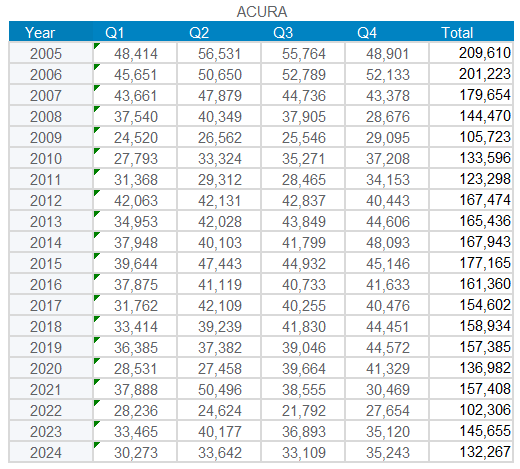
While several members on here say that out of the 13 to 15 million new vehicle sales market in the US, Slate has to just tap 1% of the market. Yet the cost structure of automobile making for nearly every automaker shows that 150,000-unit sales of a specific model is not easily achievable and low-volume sales models are difficult to be profitable. Below are Acura's sales numbers for the past 20 years. Acura has the benefit of the parent Honda that sells millions of cars worldwide every year and has huge economies of scale, and its cars are expensive with high profit margins. If Acura was a standalone manufacturer in the US, no way it survives on these low sales volumes.

Slate Auto Pickup Truck Slate starting price isn't set yet says CEO (per Insideevs interview) Screenshot 2026-01-29 081229


And just a note. Yesterday there was a story about the Bezos-owned Washington Post newspaper that is planning on firing half of its newsroom staff in the light of the paper losing $70M/year. $70M is peanut money to Bezos, but business is business and the business of business is to make a profit.
 
Last edited:

beatle

Well-Known Member
Joined
Jan 13, 2026
Threads
0
Messages
68
Reaction score
121
Location
Springfield, VA
Vehicles
'23 R1T, '97/25 Miatas, '19 Monkey
Technically it was only 6 years since they were founded in 2003 and they turned a small profit on the first Roadster in 2009:

https://en.wikipedia.org/wiki/Tesla...nced in early August,revenue of US$20 million.

But realistically yeah, it was around a decade since their first profit was in late 2019. They did spend a lot on the supercharger network which was a drag on their balance sheet, but they also got to sell a lot of ZEV credits to other automakers. That revenue source has all but dried up now which will make for some significant revenue headwinds for new automakers.
 

metroshot

Well-Known Member
First Name
Pat
Joined
Apr 30, 2025
Threads
4
Messages
239
Reaction score
269
Location
CA
Website
www.kudo-ume-farms.com
Vehicles
Mach E + Honda PHEV
Technically it was only 6 years since they were founded in 2003 and they turned a small profit on the first Roadster in 2009:

https://en.wikipedia.org/wiki/Tesla_Roadster_(first_generation)#:~:text=Tesla announced in early August,revenue of US$20 million.

But realistically yeah, it was around a decade since their first profit was in late 2019. They did spend a lot on the supercharger network which was a drag on their balance sheet, but they also got to sell a lot of ZEV credits to other automakers. That revenue source has all but dried up now which will make for some significant revenue headwinds for new automakers.
100% correct!

Ford is still trying make a profit on their EV line but recently dropped the Lightning model in favor of PowerBoost hybrid trucks .

Tesla's Supercharger network is what saved me from dumping the Ford EV.

If it wasn't for Supercharger network opening up for Ford (the first non Tesla brand) to access in April 2023 - Ford would have lost me forever.

Now, I pay a $12.99 monthly subscription to Tesla to get a lower rate at their Superchargers.

Charging at least 3 times month pays for the subscription.

Hoping when Slate comes out, Tesla will do the same as Ford and allow me to get the same discounted rate.
 

Sandman614

Well-Known Member
Joined
Aug 5, 2025
Threads
0
Messages
55
Reaction score
133
Location
NC
Vehicles
2004 Honda Element
Technically it was only 6 years since they were founded in 2003 and they turned a small profit on the first Roadster in 2009:
Well if you're gonna get technical you should probably mention that was for a single month. In general when people talk about profit or loss they are usually speaking about quarterly or annual like in a 10-K or a 10-Q.
 

beatle

Well-Known Member
Joined
Jan 13, 2026
Threads
0
Messages
68
Reaction score
121
Location
Springfield, VA
Vehicles
'23 R1T, '97/25 Miatas, '19 Monkey
Yep, 2019 wasn't all profitable, only the last quarter. 2020 was the first profitable full year for Tesla.

We're talking about Tesla here as a case study, but there are other large pieces of the puzzle that are much different for Slate that may change the trajectory for profitability for better or worse:
  • No (or very few) ZEV credits to sell
  • Much lower projected per-vehicle cost vs. expensive initial flagships of other brands
  • Much lower CAPEX for factory due to no paint
  • No investment in charging network
  • Little to no investment in proprietary tech, mostly commodity parts
  • Little to no investment in service center buildings, outsourced repairs.
 

cadblu

Well-Known Member
Joined
Apr 28, 2025
Threads
62
Messages
685
Reaction score
1,366
Location
New York
Vehicles
Tesla
The question comes - how long can a startup incinerate money on their way to profitability?
Your analogy is spot on. A few years back I recall an interview with Musk at the Gigafactory in Austin. He asked the interviewer, “you hear that whirring sound inside the factory? That’s the sound of burning cash” …alluding to the factory as a ‘cash furnace.’

It took Tesla some 16 years to start making a profit, and that was by selling their premium, high margin vehicles like Model S / X. *

Their top selling Models 3 and Y were introduced around 2017 which helped them achieve margins.

Regarding Slate, with only one basic variant in the mix, in theory they should reach profitability earlier, but not in year 2 of production as they indicated. The add-ons and accessories market may backfill losses in vehicle production. This assumes a strong demand for the ER battery at time of order. And later on, demand for OEM SUV kits, audio equipment, spare tire carriers, running boards, etc. during the first couple of years of ownership will help Slate to achieve profitability.

* Yesterday, Tesla announced they are discontinuing production on Model S / X in 2Q26.
 

ScooterAsheville

Well-Known Member
First Name
Scooter
Joined
Jul 25, 2025
Threads
9
Messages
266
Reaction score
621
Location
Asheville, NC
Vehicles
Maverick, Volvo
Your market clearing price has to make a worthwhile profit. Profit is based on manufacturing cost.

Ask Jim Farley about it.
I think Jim Farley would say something like, "Build something as appealing to the customer as the Maverick on a cost/content basis, and you can raise the price by 33% in four years and still sell all you can build". Because that's what Ford did. Now, in fairness, I think he would add "But don't have two dozen recalls". Farley would also say "It's nice to run Hermosillo at 100% capacity", which they do. Hermosillo is a money printing machine.

There are a few rules of thumb in the auto industry. One is that you have to run a plant pretty close to capacity (60 to 80 percent) to make a cent, but as you near capacity you are printing money. Another is that, because of the billion plus needed to introduce a new model, you don't make a penny on a program basis for a year or more. And another ironclad rule - you have to have meaningful scale to survive. Scale is the thousand pound gorilla of the auto industry (aside from the luxury boutique makes).

Slate's survival is really simple. Scale or die. That's the future question nobody on this forum, nobody at Slate, and nobody in the industry can answer in January 2026. Because you have to actually put Slate on the market and see how many Americans decide they want to buy (the content, cost and functionality are better than other options). And ask Elon how that went with the Cybertruck.

  • Slate will be a brilliant success. Everyone will want one. There will be year long waitlists (in other words, the Maverick story).
  • Slate will muddle along on low volume and eventually fail or get bought
  • Slate won't even make it to market because the Seriec C round will fail to deliver the investment needed to move to production.
  • Slate will hit it out of the ballpark because of fleet sales
  • Slate will break even on the vehicle, but be incredibly profitable on accessories
Pick your narrative. Your narrative is as good as anyone's narrative. Because we're all trying to predict the behavior of 15 million annual (and fickle) Am,erican car purchasers.

PS: If you asked me how it's going to go for Slate, I'd shrug and say "dunno". I don't have a narrative. Not a negative nelly or hater. Not a rabid fanboy. Just an observer of the auto industry cheering for an underdog that's trying something fascinating.
 
Last edited:
 
Top