
Worst-case Scenario Range Estimates for each battery type (my calculations)

E90400K

Well-Known Member
First Name
Francis
Joined
Apr 26, 2025
Threads
5
Messages
993
Reaction score
859
Location
Under a Bridge in the Middle of the Mid Atlantic
Vehicles
A Ford truck
Less than 25% of what?

Electric vehicles (EVs) typically recover about 60 to 70% of the kinetic energy during braking through regenerative braking. On average, this can translate to around 22% of the total driving energy being recaptured, with some models achieving higher efficiencies in specific conditions.​

Regenerative is a big benefit for the Truck in particular because it's particularly well-suited for, if not specifically designed for, local-use runabout purposes rather than as a Highway Cruiser.
Here we go again... 22% is less than 25%, isn't it.
 

Dorbiman

Well-Known Member
Joined
May 30, 2025
Threads
3
Messages
485
Reaction score
774
Location
WA
Vehicles
2005 GTO, 2005 Silverado
I think the biggest difference is consumer EVs don't have multispeed transmissions like ICEVs. Gearing for lower RPMs allow fairly inefficient vehicles to achieve decent mileage
 

AZFox

Well-Known Member
Joined
Apr 29, 2025
Threads
42
Messages
1,871
Reaction score
2,636
Location
Arizona
Vehicles
Honda NC700X
Considering EV lose between 15% to 35% efficiency in cold weather operation (depending on manufacturer and model), whereas ICEV lose just a few percent (if that).
First of all, fortunately that loss can be mitigated by pre-conditioning.

Secondly, even without that EVs still have an efficiency advantage.

For example, if @GaRailroaders's Leaf achieves 123 MPGe ("MPG equivalent") in good weather and loses 25% efficiency it's still getting 92 MPGe in city driving, which is pretty good!

So even in cold weather an EV powertrain provides a significant efficiency advantage over a less-efficient ICEV powertrain with something like eighty times the number of moving parts.

Incidentally, Slate has claimed a combined MPG equivalent of 96 for the Truck.
 

AZFox

Well-Known Member
Joined
Apr 29, 2025
Threads
42
Messages
1,871
Reaction score
2,636
Location
Arizona
Vehicles
Honda NC700X
Here we go again... 22% is less than 25%, isn't it.
Indeed, but what you wrote is misleading because you didn't specify that your percentage was of total driving energy rather than kinetic energy during braking.

To summarize...

During braking, ICEVs convert the vehicle's kinetic energy to heat energy and dissipate the heat into the air. Electric vehicles can use regenerative braking to recapture 60 to 70% of kinetic energy instead.

That's a big deal.

Even without that, an EV powertrain provides a significant efficiency advantage over a less-efficient ICEV powertrain with its vastly higher number of moving parts.
 

AZFox

Well-Known Member
Joined
Apr 29, 2025
Threads
42
Messages
1,871
Reaction score
2,636
Location
Arizona
Vehicles
Honda NC700X
EV do better in urban traffic environments because EV consume very little energy at idle (i.e. not moving) so there is much less heat loss as compared to ICEV.
That may contribute, but it's mostly other things that invert the city/highway proportions for EVs.

ICEVs inherently waste around 70% of the energy in gasoline. That's especially a bummer when the vehicle isn't moving, hence we have the annoying start/stop systems.
 

AZFox

Well-Known Member
Joined
Apr 29, 2025
Threads
42
Messages
1,871
Reaction score
2,636
Location
Arizona
Vehicles
Honda NC700X
I think the biggest difference is consumer EVs don't have multispeed transmissions like ICEVs. Gearing for lower RPMs allow fairly inefficient vehicles to achieve decent mileage
Yes that's part of it for sure.

Aerodynamic dag contributes a lot. EV motors are more energy efficient under a moderate load than they are under a heavy load when pushing a lot of wind.

See also this thread:
You can go fast or you can go far, but you can't do both

I think battery characteristics also contribute. Slower battery drain is more efficient than faster battery drain.

Regenerative braking in the City and inherent inefficiency on the Highway provide a on-two punch that favors the former over the latter for EVs.
 

cadblu

Well-Known Member
Joined
Apr 28, 2025
Threads
73
Messages
973
Reaction score
1,896
Location
New York
Vehicles
Tesla
I've spent a lot of time recently thinking about which battery option I should get, and that has led me down a rabbit hole of analyzing worst-case scenarios and thinking about what are my most realistic needs day-to-day....
Anyways, for anyone whose made it this far through my rambling assumptions, I'd love to hear your thoughts on this, as well as your own range needs and estimates!
I thought it appropriate to revisit this thread using a data-driven analysis which appears in the "reservation" post as of today.

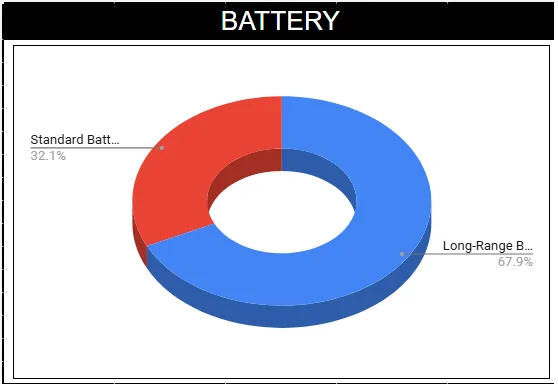
Even without formally replying to this thread, the "silent majority" has spoken, and it definitely appears that more folks prefer the Long-Range battery by a convincing 2/3 majority. That's enough votes to over-ride a Presidential veto. LOL

Slate Auto Pickup Truck Worst-case Scenario Range Estimates for each battery type (my calculations) 1778072627270-0y
 

KevinRS

Well-Known Member
First Name
Kevin
Joined
Jul 4, 2025
Threads
5
Messages
1,250
Reaction score
1,451
Location
California
Vehicles
Nissan Versa
I thought it appropriate to revisit this thread using a data-driven analysis which appears in the "reservation" post as of today.

Even without formally replying to this thread, the "silent majority" has spoken, and it definitely appears that more folks prefer the Long-Range battery by a convincing 2/3 majority. That's enough votes to over-ride a Presidential veto. LOL

1778072627270-0y.webp
The thing is that is tracking a tiny minority 773 self selected people on this forum, out of somewhere over 110k. I have to think that the people who haven't bothered to find this forum, sign up, and answer that poll, probably skew more towards the standard battery, and it's probably closer to 50/50 overall.
A lot also depends on pricing. If long range was cheap enough, I might just go with it as insurance, though I shouldn't need it.
Someone here came up with an estimate, but that was purely based on wholesale cost of cells. If we get actual numbers next month, some new polling will probably be in order, and Slate may also start sending emails asking people what their choices are in battery and other options, along with confirming how many people are still interested enough to respond.
 
  • Like
Reactions: Ali

Twisted Santa

Member
First Name
David
Joined
Aug 20, 2025
Threads
0
Messages
16
Reaction score
36
Location
California
Vehicles
Tacoma
I’m in the minority standard battery group on this poll. Range is not an issue for me at all. I very rarely go more than 40 miles a day in my current truck, and my wire’s comfortable car will be the obvious choice for road trips.
If the price difference isn’t that great, I might spring for the larger battery, but probably not. What I’m really waiting for before I make my decision, is some road test data that compares the actual performance of the two types. Will one be slightly more efficient than the other (miles per kw/h)? Will the larger battery version offer a few extra pounds of towing capacity? I hope Slate releases some info like that before we have to make decisions on our orders. Can’t wait for June!
 
  • Like
Reactions: TPL

sodamo

Well-Known Member
First Name
David
Joined
May 19, 2025
Threads
8
Messages
1,260
Reaction score
1,565
Location
Big Island Hawaii
Vehicles
Tundra 1794, Subaru Ascent
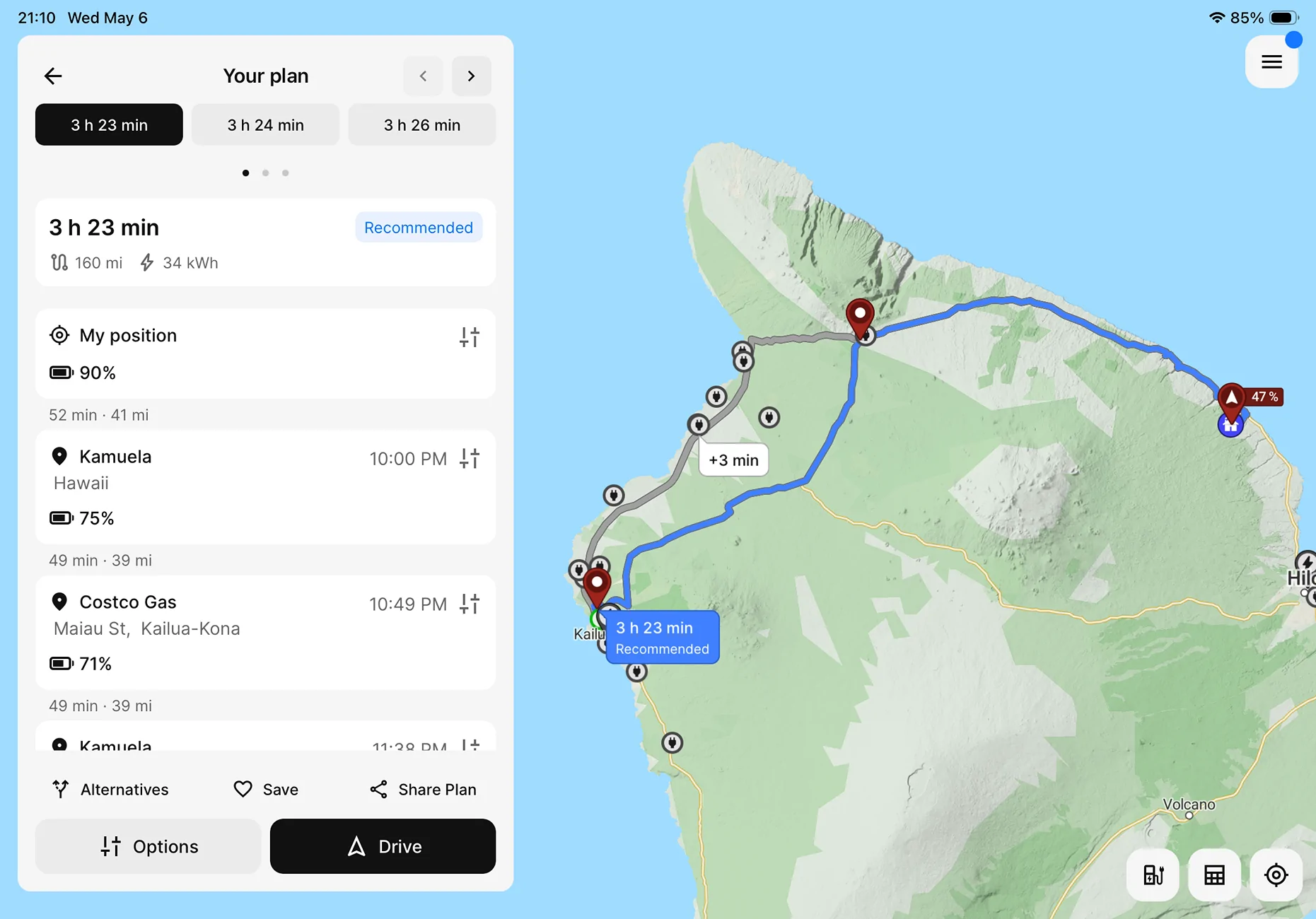
I’ve been on the fence, but leaning toward standard battery, unless the cost of the extended was just so attractive. In my case the standard covers all my expected driving excepting about 5 trips a year of 160 miles round trip. A primary goal of mine is only pay for emergency charging.
But if I did this correctly, ABRP app says this trip is totally doable, guessing due to regen. So even more confident in my standard battery choice.

Slate Auto Pickup Truck Worst-case Scenario Range Estimates for each battery type (my calculations) IMG_1096
 

GaRailroader

Well-Known Member
First Name
PJ
Joined
Apr 26, 2025
Threads
12
Messages
413
Reaction score
679
Location
Atlanta, GA
Vehicles
2026 Tesla Model Y Premium, 2018 Tesla Model 3 LR
One of our forum members attended a fleet event and indicated that there is a battery announcement coming in June that will make the standard battery wildly popular. I am guessing different chemistries for standard range and extended range. Perhaps LFP for standard and NMC for long range. If chemistries are the same I would favor long range, however if not I would likely go standard range.
 

Shrink36s

Well-Known Member
Joined
Apr 16, 2026
Threads
1
Messages
68
Reaction score
121
Location
Michigan
Vehicles
'18 Equinox
One of our forum members attended a fleet event and indicated that there is a battery announcement coming in June that will make the standard battery wildly popular. I am guessing different chemistries for standard range and extended range. Perhaps LFP for standard and NMC for long range. If chemistries are the same I would favor long range, however if not I would likely go standard range.
Interesting. Can hardly wait to hear more.

I lean extended simply because when I leave my small city, it is always more than a 150 mile round trip, and most often less than 220 miles. The vast majority of the time, though, I’m around town and could do that daily for probably 10-days and stay under 150.
Depends on price. If it’s too expensive, I’ll just have to adjust to a recharge stop.
 

ScooterAsheville

Well-Known Member
First Name
Scooter
Joined
Jul 25, 2025
Threads
13
Messages
506
Reaction score
1,129
Location
Asheville, NC
Vehicles
Maverick, Volvo
About the lack of a transmission affecting range. Apologies because I don't recall the details all that well. But I think it's a miniscule effect. I do recall that it was a tiny, tiny, tiny improvement in motor efficiency - mainly because the motor designer could make fewer design compromises. If you're interested in this stuff, Munro Live has some great videos where Paul (I think) dives into BEV motor and drivetrain design compromises. I thought batteries were complex until I watched those videos on various motor designs and the compromises made for each.

If a transmission gave 50 extra miles on a BEV, I can assure everyone that every BEV would have a transmission instead of a reduction gear. Those guys will stand on their heads for an hour for 1 mile of extra range.
 
  • Like
Reactions: TPL

beatle

Well-Known Member
Joined
Jan 13, 2026
Threads
2
Messages
246
Reaction score
448
Location
Springfield, VA
Vehicles
'23 R1T, '97/25 Miatas, '19 Monkey
Multi speed transmissions have additional cost, complexity, weight, and size/packaging challenges. They can improve both acceleration and range as seen with the Taycan/ETron, but they're generally not worth it since electric motors are already so flexible. In the vast majority of EVs, It makes more sense to overengineer the motor for extreme cases than it does to change gears, and even still a second ratio is still not always necessary to meet the goal. For example, the Model S plaid can hit 200mph with only a gear reduction and it still gets well over 300 miles of range.
 
 
Top