Sponsored

Range vs Wheels size

kvermeer

Well-Known Member
First Name
Kevin
Joined
Mar 29, 2026
Threads
10
Messages
426
Reaction score
969
Location
Grand Rapids, MI
Vehicles
Toyota Sequoia, Toyota Highlander, Ford Escape, (previously) Ford Ranger
Different tire diameters don't, by themselves, change the number of watt/hours it takes to dive a given distance. It just changes he gear ratio. If the motor turns more slowly at a given speed, it will take more amps, fewer volts. If it turns faster, more volts, fewer amps. Volts times amps = watts. And (kilo)watt/hours are what the battery stores. Changing the tire size can have an aerodynamic effect, but I have to think that Slate's engineers have optimized the wheel and tire size for range.
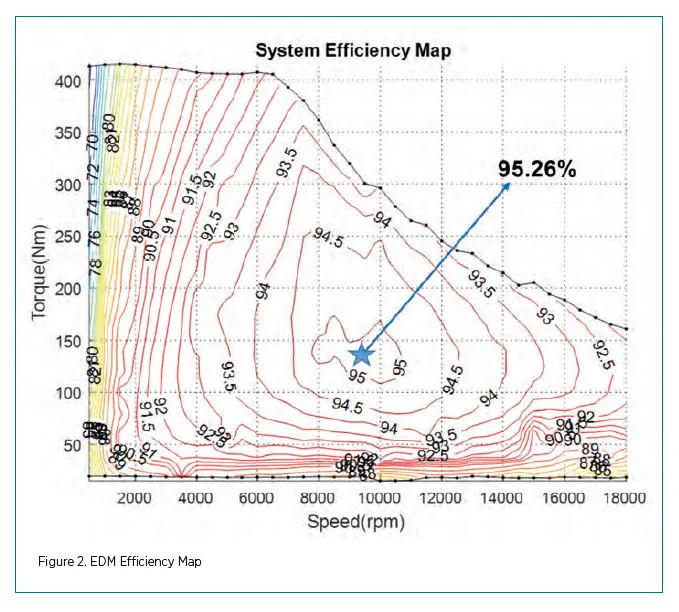
Changing the gear ratio has a slight efficiency impact - here's a chart from JJE (Slate's motor manufacturer) for a very similar motor:

Slate Auto Pickup Truck Range vs Wheels size bild2-edm
=

(Source press release here. That 300 kW motor with locker might be a nice crate motor upgrade for a high-performance Slate!)

The torque required to move the vehicle at various speeds on level ground will be a parabola through that efficiency map going up and to the right, changing wheel size will shift that parabola sideways. There's a particular gear ratio where the parabola goes through the max efficiency star in the center, I expect that Slate will have chosen the final drive ratio such that this efficiency is achieved with the standard tires to maximize range.

Larger tires will shift the parabola to the left, slightly reducing efficiency. But that's merely changing the efficiency from 95.2 to maybe 94.5, relatively insignificant.

 

Kopsis

Well-Known Member
First Name
David
Joined
Dec 7, 2025
Threads
0
Messages
206
Reaction score
587
Location
Arizona
Vehicles
Kia EV6
On the bright side less unsprung weight and rotational mass provide other benefits.
Many 20" alloy rims are the same weight or heavier than their 17" steel counterparts. Aluminum isn't a free lunch. It's about 3x less dense but it's also about 3x weaker so you have to use more to achieve the same strength. To further complicate things, aluminum has a fatigue limit (most steels don't) so aluminum rims are often "overbuilt" with additional material to eliminate any cyclic flexing that would lead to fatigue failure.
 

Rocks

Well-Known Member
Joined
Jun 24, 2026
Threads
1
Messages
198
Reaction score
399
Location
AZ
Vehicles
Maybe Slate
I wouldn't be opposed to a set of 19s to fit a set of the nice LRR EV tires. Steelies if possible. And keeping the same overall diameter.
 

Johnologue

Well-Known Member
First Name
John
Joined
Dec 14, 2025
Threads
1
Messages
304
Reaction score
603
Location
WA, USA
Vehicles
2017 Hyundai Veloster
Since wheels and tires are already open industry standards, I'm curious about how many more options might be possible. Aside from smaller rims (seems another thread mentioned it was unlikely/unclear if 16s would fit) or overall diameter, what about narrower? The default dimensions are 245/65/17, and based on various offhand comparisons, that seems a bit wide. There are probably rolling resistance gains to be had by dropping to something like 225.

Not sure if/how much the increased base weight and payload ratings would affect the discussion.
 

fxrdr31

Well-Known Member
First Name
Andrew
Joined
Jun 18, 2026
Threads
1
Messages
46
Reaction score
76
Location
Wayne, MI, United States
Vehicles
Ford F150
The more I think about it I feel like a smaller wheel and tire combo along with the lower kit would be a great fit for making the range but could be wrong
 

FloppaEnjoyer8067

Well-Known Member
Joined
May 6, 2026
Threads
5
Messages
99
Reaction score
168
Location
minnesota
Vehicles
2016 bmw 428
Since wheels and tires are already open industry standards, I'm curious about how many more options might be possible. Aside from smaller rims (seems another thread mentioned it was unlikely/unclear if 16s would fit) or overall diameter, what about narrower? The default dimensions are 245/65/17, and based on various offhand comparisons, that seems a bit wide. There are probably rolling resistance gains to be had by dropping to something like 225.

Not sure if/how much the increased base weight and payload ratings would affect the discussion.
Rolling resistance does not have a linear response to width. There’s a lot more that goes into it unfortunately.

Source: tire engineer at my work I’ve been pestering the past few months to learn more.
 

AZFox

Well-Known Member
Joined
Apr 29, 2025
Threads
54
Messages
2,313
Reaction score
3,863
Location
Arizona
Vehicles
Honda NC700X
The default dimensions are 245/65/17, and based on various offhand comparisons, that seems a bit wide. There are probably rolling resistance gains to be had by dropping to something like 225.
Also less weight and less wind resistance.

Incidentally the "next size down" from stock, 235/65R17, is only 1.7% smaller in both radius and diameter. There are some good tire choices in that size, which probably is because of the type of vehicles that come with that size from the factory.

- https://tiresize.com/tiresizes/245-65R17.htm
- https://tiresize.com/tiresizes/235-65R17.htm
 

EV Trek

Well-Known Member
First Name
Tim
Joined
Aug 5, 2025
Threads
11
Messages
880
Reaction score
1,581
Location
Johnson City Tennessee
Vehicles
2024 Equinox EV, 2001 Chevy Monte Carlo
Several reasons not to set the pressure to the max pressure on the sidewall.
My Tire guy says never to set your pressures more than 5 psi over the reccomended pressure by the manufacturer of your vehicle.

What Happens If You Run at Max PSI?


If you inflate your tires to the maximum number on the sidewall (which is often around 40 to 50 PSI for standard passenger cars), you will likely experience a few negative side effects:


Reduced Traction and Grip: Over-inflating a tire causes the center of the tread to bulge out slightly. This shrinks your tire's "contact patch"—the actual amount of rubber touching the road. Less rubber on the road means less grip, which compromises your braking distance and cornering safety, especially in wet conditions.


Harsh, Bumpy Ride: Air acts as a primary cushion for your suspension. At max PSI, the tire becomes stiff as a rock. You will feel every single pebble, pothole, and expansion joint in the road, which can also accelerate wear on your suspension components.


Uneven Center Wear: Because the center of the tread is bulging out, it will bear the brunt of the vehicle's weight and friction. Your tires will wear out prematurely down the exact middle of the tread, forcing you to replace them much sooner.


Higher Risk of Blowouts from Impact: A rigid, max-inflated tire has no flex left in it. If you hit a sharp pothole or debris at high speed, the tire can't absorb the shock by compressing. Instead, it is much more likely to suffer an internal cord snap or an immediate blowout.
 

Tom Sawyer

Well-Known Member
Joined
Jan 11, 2026
Threads
1
Messages
695
Reaction score
836
Location
Northeast Ohio
Vehicles
CJ-7
Several reasons not to set the pressure to the max pressure on the sidewall.
My Tire guy says never to set your pressures more than 5 psi over the reccomended pressure by the manufacturer of your vehicle.

What Happens If You Run at Max PSI?


If you inflate your tires to the maximum number on the sidewall (which is often around 40 to 50 PSI for standard passenger cars), you will likely experience a few negative side effects:


Reduced Traction and Grip: Over-inflating a tire causes the center of the tread to bulge out slightly. This shrinks your tire's "contact patch"—the actual amount of rubber touching the road. Less rubber on the road means less grip, which compromises your braking distance and cornering safety, especially in wet conditions.


Harsh, Bumpy Ride: Air acts as a primary cushion for your suspension. At max PSI, the tire becomes stiff as a rock. You will feel every single pebble, pothole, and expansion joint in the road, which can also accelerate wear on your suspension components.


Uneven Center Wear: Because the center of the tread is bulging out, it will bear the brunt of the vehicle's weight and friction. Your tires will wear out prematurely down the exact middle of the tread, forcing you to replace them much sooner.


Higher Risk of Blowouts from Impact: A rigid, max-inflated tire has no flex left in it. If you hit a sharp pothole or debris at high speed, the tire can't absorb the shock by compressing. Instead, it is much more likely to suffer an internal cord snap or an immediate blowout.
Do radial tires bulge from high pressure?
 

Johnologue

Well-Known Member
First Name
John
Joined
Dec 14, 2025
Threads
1
Messages
304
Reaction score
603
Location
WA, USA
Vehicles
2017 Hyundai Veloster
Rolling resistance does not have a linear response to width. There’s a lot more that goes into it unfortunately.

Source: tire engineer at my work I’ve been pestering the past few months to learn more.
I wouldn't expect it to be linear, but do you mean narrower tires might have negligible impact or that they might actually have higher RR? I know the design/compound of the specific tire is going to have an impact anyways.

Lower unsprung/rotating mass still seems like a good thing. I've also seen claims that narrower tires have better low-traction behavior (ground pressure) and more resistance to hydroplaning. Can't say I've had a tire engineer on hand to pester, though.


Several reasons not to set the pressure to the max pressure on the sidewall.
Oh, yeah. Don't under/overinflate your tires. More wear, worse ride, less grip, higher blowout risk and all that. Not worth anything you could possibly get out of it.
 

FloppaEnjoyer8067

Well-Known Member
Joined
May 6, 2026
Threads
5
Messages
99
Reaction score
168
Location
minnesota
Vehicles
2016 bmw 428
I wouldn't expect it to be linear, but do you mean narrower tires might have negligible impact or that they might actually have higher RR? I know the design/compound of the specific tire is going to have an impact anyways.

Lower unsprung/rotating mass still seems like a good thing. I've also seen claims that narrower tires have better low-traction behavior (ground pressure) and more resistance to hydroplaning. Can't say I've had a tire engineer on hand to pester, though.


Oh, yeah. Don't under/overinflate your tires. More wear, worse ride, less grip, higher blowout risk and all that. Not worth anything you could possibly get out of it.
I will ask more probing questions. Right now everything I say is a theory, but I’m guessing a wider tire changes the contact pressure and areas which have more complicated effects. Plus moments, load distribution, and who knows what else.

My question to him was directly “for the same make and model tire, will increasing tire width increase rolling resistance semi-linearly?”

Tires are complicated. Our rudimentary model for a college project was 220 parameters.
 

Tom Sawyer

Well-Known Member
Joined
Jan 11, 2026
Threads
1
Messages
695
Reaction score
836
Location
Northeast Ohio
Vehicles
CJ-7
Yeah, you'll see wear down the center of the tire and not the sides over time.
I appreciate your input. I don't know your credentials on the matter or if you're just sharing your opinion so I looked this up online and couldn't find much info that addresses whether steel belted radial tires deform and bulge at the tread surface under high inflation pressures.

My search terms were "Do steel belted radial tires bulge at the tread from high pressure?" Without relying on an AI response, I went with an article put together by Tire Rack that discusses inflation pressure. It doesn't specifically address deformation but focuses on safety:

When (Tire) Inflation is Good For the (Fuel) Economy*
TireRack.com said:
*Fuel Economy, That is. And More.
Maintaining correct tire inflation pressure helps optimize tire performance and fuel economy. Correct tire inflation pressure allows drivers to experience tire comfort, durability and performance designed to match the needs of their vehicles. Tire deflection (the tread and sidewall flexing where the tread comes into contact with the road) will remain as originally designed and excessive sidewall flexing and tread squirm will be avoided. Heat buildup will be managed and rolling resistance will be appropriate. Proper tire inflation pressure also stabilizes the tire's structure, blending the tire's responsiveness, traction and handling.
Disadvantages of Underinflation
An underinflated tire can't maintain its shape and becomes flatter than intended while in contact with the road. If a vehicle's tires are underinflated by only 6 psi it could lead to tire failure. Additionally, the tire's tread life could be reduced by as much as 25%. Lower inflation pressure will allow the tire to deflect (bend) more as it rolls. This will build up internal heat, increase rolling resistance and cause a reduction in fuel economy of up to 5%. You would experience a significant loss of steering precision and cornering stability. While 6 psi doesn't seem excessively low, remember, it usually represents about 20% of the tire's recommended pressure.
Disadvantages of Overinflation
An overinflated tire is stiff and unyielding and the size of its footprint in contact with the road is reduced. If a vehicle's tires are overinflated by 6 psi, they could be damaged more easily when running over potholes or debris in the road. Higher inflated tires cannot isolate road irregularities well, causing them to ride harsher. However, higher inflation pressures usually provide an improvement in steering response and cornering stability up to a point. This is why participants who use street tires in autocrosses, track events and road races run higher than normal inflation pressures. The pressure must be checked with a quality air gauge as the inflation pressure cannot be accurately estimated through visual inspection.
 

Orley

Well-Known Member
Joined
Dec 18, 2025
Threads
3
Messages
88
Reaction score
136
Location
52317
Vehicles
2015 subaru forester
Bicycle tires for road bikes once came with 700x23 or 700x25 tires inflated to over 100 psi. Bikes now use 700x28, 30 or larger inflated to 60 psi or less. The theory today is that fatter low psi tires roll fast because there is less wheel chatter and they maintain contact w the road. This results in less rolling resistance. Does this work for truck tires? IDK


Top