Extended Battery Gone?

Sneetches

New Member
First Name
Nathan
Joined
Jun 5, 2026
Threads
0
Messages
4
Reaction score
7
Location
Pensacola, Fl
Vehicles
Equinox EV
I'm torn about this. I was planning on getting the extended range battery and willing to pay extra for it. In reality, it's not like 205 is any different from 240 for a vehicle that will see less than 15 miles a day 99.9% of the time.

Still, it feels like I'm getting less than I expected while also paying less than I expected.

It's about equal to me since and LFP battery likes to be charged to 100% and a NMC is best at 80%. So realistically it's about the same for daily use. I'm actually pretty okay with this decision since it saves $3k+ for an extended range battery. I can use that for a charging station at home. ( I currently charge at work.)
 

Supernintendo Chalmers

Well-Known Member
First Name
Dave
Joined
Jun 14, 2026
Threads
0
Messages
48
Reaction score
79
Location
The HOTTEST Country!!!
Vehicles
2025 Volvo EX30 AWD, 2001 Ford Ranger XLT
I’m super excited with this change in production. This brings the vehicle in much closer with my expectations for the Ford Ranchero base model. The Ranchero will be more efficient, with a smaller LFP, but it’s also bigger, chunkier, more complex and less truck-y. My only conceivable Slate gripe is the fastcharge speed, but I’m not willing to pay the premium for an 800v system. Maybe just get a basic tonneau cover or replace my next tires with LRR for the two annual highway trips I do that are more than 90 miles.

This new development checks the last boxes I had outstanding- LFP (High Desert dweller) and 200+ range. āœ… I’m in.
 

Rocks

Well-Known Member
Joined
Jun 24, 2026
Threads
1
Messages
130
Reaction score
229
Location
AZ
Vehicles
Maybe Slate
This new development checks the last boxes I had outstanding- LFP (High Desert dweller) and 200+ range. āœ… I’m in.
I though it was funny when they released the hot weather testing vid. They basically went by my house to go up over Union Pass.

Just saw the mystery truckstop on I-40/Griffin Rd south of Kingman got the signage up. It's a Love's with a separate canopy that's probably for chargers.
 

bloo

Well-Known Member
Joined
Nov 7, 2025
Threads
3
Messages
448
Reaction score
829
Location
New England
Website
thebluearecoming.com
Vehicles
'21 Kia Seltos 2.0 AWD
Just remember with LFP you can charge to full range every day, with the extended range it was recommended to only 80% daily charge. So you get 205 every day with the standard range or 192 daily for the old extended range.
The LFP would have been more efficient with the higher voltage and lower weight. And the capacity hit in winter wouldn't be as severe.
 

SparkYellow

Well-Known Member
First Name
Sam
Joined
Nov 17, 2025
Threads
17
Messages
375
Reaction score
543
Location
Bay Area & Central Valley
Vehicles
6MT hatchback, 5MT coupe, CUV, large SUV, cargo van
For the base price tag under $25K, getting 205 miles is an excellent deal IMO.

My Mach E gets 200 miles range at more than double the price - so I am quite tickled at Slate!

Here's an option:
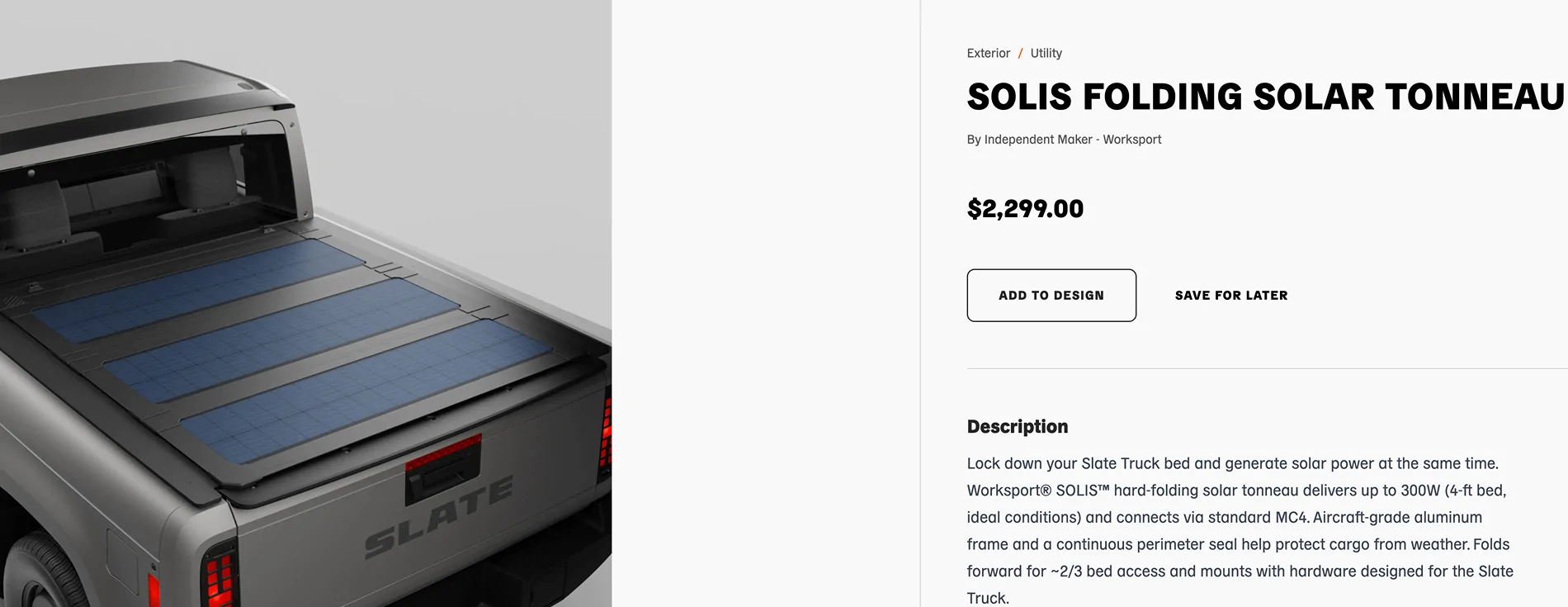
Just get the Solar power tonneau cover and you will have extra range all day long.

Screenshot 2026-06-24 at 6.21.38 AM.webp
I looked into it and felt the yield is low. Truck will be mostly parked in the shade during the week. Work trips are 3 hours round trip max. Weekend road trips are 3 hours max each way and full sun at camp. I can make my own solar tonneau with two 200w flexible panels, but the most I can get are 2 to 3 miles per day from driving. I might as well stow the panels in the cab while driving and deploy them when I am parked at camp.

I will have one fixed on the hood and another fixed on the roof. At camp, with two more laid across the bed, I can get 800w max. Two 100ah lifepo4 batteries, 60A charge controller, 2000w inverter, all together roughly $1500. Cousin Eugene ran the solar calculation for me. Need to double check with Connie and maybe Chad.
 
Last edited:

GrizzlysGhost

Well-Known Member
Joined
May 28, 2026
Threads
3
Messages
391
Reaction score
1,008
Location
Montana
Vehicles
Hummer H3, Toyota Tacoma, Subaru Outback, Indian Chief Vintage
I will have one fixed on the hood and another fixed on the roof. At camp, with two more laid across the bed, I can get 800w max. Two 100ah lifepo4 batteries, 60A charge controller, 2000w inverter, all together roughly $1500. Cousin Eugene ran the solar calculation for me. Need to double check with Connie and maybe Chad.
Isn't Eugene the one with dyslexia? Good call to check him. Gotta catch Connie and Chad between fights, but erything should work out. Good luck have fun.
 

SparkYellow

Well-Known Member
First Name
Sam
Joined
Nov 17, 2025
Threads
17
Messages
375
Reaction score
543
Location
Bay Area & Central Valley
Vehicles
6MT hatchback, 5MT coupe, CUV, large SUV, cargo van
Isn't Eugene the one with dyslexia? Good call to check him. Gotta catch Connie and Chad between fights, but erything should work out. Good luck have fun.
I asked Eugene if there's a "Gandalf" in his field, he said yes, WolframAlpha. I don't even know what questions to ask Sir Wolfram. 😬
 

The Dude

Well-Known Member
Joined
Apr 28, 2025
Threads
1
Messages
73
Reaction score
93
Location
Texas
Vehicles
Willys
Need to request official support from Slate for an auxiliary battery interface. If Slate is willing to expose an expansion port or publish integration specifications, I think an aftermarket Range Extender would be interesting. Sort of like a reclaimed flat pack from another donor ev that would lay flat in the bed. Hmmm. DIY weekend project.
 

Tom Sawyer

Well-Known Member
Joined
Jan 11, 2026
Threads
1
Messages
682
Reaction score
812
Location
Northeast Ohio
Vehicles
CJ-7
Just remember with LFP you can charge to full range every day, with the extended range it was recommended to only 80% daily charge. So you get 205 every day with the standard range or 192 daily for the old extended range.
I just watched the Engineering Explained video (below) for LFP batteries, and there's information in the video that seems to contradict this concept. In the video, he mentions that studies of LFP batteries show they last longer if kept at a lower state of charge. Charging to 100% helps with battery management calibration, but contributes to accelerated degradation (similar to the NMC batteries.)
So I'm not sure what to make of the contradictory information. Maybe this topic of battery longevity/degradation studies should be (yet another...) separate thread.
 

metroshot

Well-Known Member
First Name
Pat
Joined
Apr 30, 2025
Threads
7
Messages
450
Reaction score
498
Location
CA
Website
www.kudo-ume-farms.com
Vehicles
Mach E + Honda PHEV
I just watched the Engineering Explained video (below) for LFP batteries, and there's information in the video that seems to contradict this concept. In the video, he mentions that studies of LFP batteries show they last longer if kept at a lower state of charge. Charging to 100% helps with battery management calibration, but contributes to accelerated degradation (similar to the NMC batteries.)

So I'm not sure what to make of the contradictory information. Maybe this topic of battery longevity/degradation studies should be (yet another...) separate thread.
I am sure all batteries will degrade over time and use.

I have not seen any significant decrease over time with my 2 EVs.

With the SOC buffers in place, you will never get to 100% true charge, it's always under charged.

Going from my NMC battery to LFP is better for me as I charge to 100%.
 

phidauex

Well-Known Member
First Name
Sam
Joined
Nov 24, 2025
Threads
0
Messages
213
Reaction score
447
Location
Boulder, CO
Vehicles
2021 Mach E AWD, 1997 Tacoma ExCab
All lithium chemistry batteries degrade more at very high SOCs. LFP and NMC are not different in this regard. The "LFP gets more effective range because you can charge to 100% and you can't on NMC" narrative is FALSE, and has sprung out of two unrelated points:
  1. The "NMC can't be above 80%" claim is overblown - no lithium chemistry battery should be charged to 100% and left there for a long period of time, but if you are driving every day then you are always bringing the SOC down. Even if you are trying to extend the life of your battery as much as possible and limiting charge to 80 or 90%, then just charge to 100% whenever you need the longer range. Its just fine, there isn't a magical hard limit at 80%, and you can access the full range any or every day if you need it.
  2. LFP batteries have a very flat voltage curve which makes it hard to estimate SOC, so the BMS can "lose track" of where the batteries are in their charge range. This can cause real problems down the road. The solution is that you have to charge to 100% periodically to recalibrate the BMS. LFP battery manufacturers have done a successful bit of marketing judo and flipped a product downside, "Has calibration problem, must be recalibrated monthly" into a product upside "Can be charged to 100% whenever you want, gets more range!" This is a bit of BS and it is surprising how fast parts of the EV world have eaten up this claim.
At the end of the day NMC and LFP are not terribly different. LFP is cheaper, and potentially more thermally stable (though this is also somewhat overstated), but is less dense and performs a bit worse in very low temperatures. Lifespan and fire risk are more connected to who made the cell than the base chemistry.
 

LevelHeaded

Well-Known Member
Joined
Jun 17, 2026
Threads
2
Messages
63
Reaction score
150
Location
WA, USA
Vehicles
'26 IONIQ 9, '24 Sprinter, '25 4Runner
All lithium chemistry batteries degrade more at very high SOCs. LFP and NMC are not different in this regard. The "LFP gets more effective range because you can charge to 100% and you can't on NMC" narrative is FALSE, and has sprung out of two unrelated points:
  1. The "NMC can't be above 80%" claim is overblown - no lithium chemistry battery should be charged to 100% and left there for a long period of time, but if you are driving every day then you are always bringing the SOC down. Even if you are trying to extend the life of your battery as much as possible and limiting charge to 80 or 90%, then just charge to 100% whenever you need the longer range. Its just fine, there isn't a magical hard limit at 80%, and you can access the full range any or every day if you need it.
  2. LFP batteries have a very flat voltage curve which makes it hard to estimate SOC, so the BMS can "lose track" of where the batteries are in their charge range. This can cause real problems down the road. The solution is that you have to charge to 100% periodically to recalibrate the BMS. LFP battery manufacturers have done a successful bit of marketing judo and flipped a product downside, "Has calibration problem, must be recalibrated monthly" into a product upside "Can be charged to 100% whenever you want, gets more range!" This is a bit of BS and it is surprising how fast parts of the EV world have eaten up this claim.
At the end of the day NMC and LFP are not terribly different. LFP is cheaper, and potentially more thermally stable (though this is also somewhat overstated), but is less dense and performs a bit worse in very low temperatures. Lifespan and fire risk are more connected to who made the cell than the base chemistry.
Here you’ve gone and overstated the correction, IMO. I think talking in absolutes/extremes either way probably oversells the relative difference to most end users, but still,

ā€œLFP and NMC are not different in this regardā€ is too strong. Calendar-aging studies consistently show NMC’s degradation is more SOC-sensitive than LFP’s. NMC loses capacity noticeably faster when held high, while LFP’s aging is flatter across SOC. Part of the reason is absolute voltage: a full LFP cell sits around 3.65V versus ~4.2V for full NMC, and that lower top-end voltage is genuinely less stressful on the electrolyte. So LFP really is more tolerant of high SOC, not just equal.

Because of that, the range narrative isn’t simply ā€œFALSEā€, it’s overstated. The real distinction isn’t that NMC can’t hit 100%, it’s that doing it daily costs NMC more than it costs LFP. An LFP owner can routinely charge to 100% with little penalty (and is told to, for calibration); an NMC owner doing the same daily pays a bit more in degradation. So in practice LFP owners do get easier access to the full pack day-to-day. The ā€œmarketing judoā€ framing has a kernel of truth, but it’s not pure spin. The calibration need and the tolerance advantage both exist at once.

Thermal stability difference is real, not overstated. LFP’s cathode doesn’t shed oxygen during thermal runaway the way NMC’s does, and it has a higher onset temperature. That’s a real, significant safety difference.

You skip LFP’s strongest genuine edge: cycle life. LFP typically does several thousand cycles more, which matters a lot for high-mileage use.
 

phidauex

Well-Known Member
First Name
Sam
Joined
Nov 24, 2025
Threads
0
Messages
213
Reaction score
447
Location
Boulder, CO
Vehicles
2021 Mach E AWD, 1997 Tacoma ExCab
Here you’ve gone and overstated the correction, IMO. I think talking in absolutes/extremes either way probably oversells the relative difference to most end users, but still,

ā€œLFP and NMC are not different in this regardā€ is too strong. Calendar-aging studies consistently show NMC’s degradation is more SOC-sensitive than LFP’s. NMC loses capacity noticeably faster when held high, while LFP’s aging is flatter across SOC. Part of the reason is absolute voltage: a full LFP cell sits around 3.65V versus ~4.2V for full NMC, and that lower top-end voltage is genuinely less stressful on the electrolyte. So LFP really is more tolerant of high SOC, not just equal.

Because of that, the range narrative isn’t simply ā€œFALSEā€, it’s overstated. The real distinction isn’t that NMC can’t hit 100%, it’s that doing it daily costs NMC more than it costs LFP. An LFP owner can routinely charge to 100% with little penalty (and is told to, for calibration); an NMC owner doing the same daily pays a bit more in degradation. So in practice LFP owners do get easier access to the full pack day-to-day. The ā€œmarketing judoā€ framing has a kernel of truth, but it’s not pure spin. The calibration need and the tolerance advantage both exist at once.

Thermal stability difference is real, not overstated. LFP’s cathode doesn’t shed oxygen during thermal runaway the way NMC’s does, and it has a higher onset temperature. That’s a real, significant safety difference.

You skip LFP’s strongest genuine edge: cycle life. LFP typically does several thousand cycles more, which matters a lot for high-mileage use.
You are right that we can't speak in absolutes - there are a lot of small differences playing against each other, but they continually get ramped into a marketing claim that is still deceptive.

LFP's slight advantage at high SOCs is already accounted for in them using less high SOC buffer, so their 100% displayed might already be 98 or 99% chemical SOC, while an NMC vehicle may have held back more and be at 95-96% when the display is 100%. Trying to claim that benefit twice is marketing double-dipping.

You have to watch out for the thermal stability claim as well - most fires in stationary energy storage systems are from manufacturing defects in the cell. An NMC cell and an LFP cell made at the same quality level by the same manufacturer would show an advantage to LFP, but in practice LFP systems also enter thermal runaway, and there are a greater number of small/sketchy LFP manufacturers than NMC manufacturers.

And watch the cycle life claim too, NMC batteries usually rate their end of life closer to 70% SOH, and LFP manufacturers go down to 60% SOH. That makes the cycle count look higher, even though the annual degradation rate over a long duration might actually be higher. There is a lot of manufacturer variation in these degradation rates as well - it isn't just down to the chemistry.

At the end of the day it mostly comes out in the wash, and I don't think buyers should veto either chemistry. Manufacturers have a harder decision to make, but density and pack voltage will be the biggest drivers.

EDIT: And if I sound a little peeved I apologize, some work stress bleeding through. My company buys many GWhs of batteries every year, multiple chemistries and suppliers, US and elsewhere, and threading the webs of contradictory claims they make is quite vexing. Competition is extremely high in the space and it makes getting straight answers, or clear data, difficult.
 
Last edited:

LevelHeaded

Well-Known Member
Joined
Jun 17, 2026
Threads
2
Messages
63
Reaction score
150
Location
WA, USA
Vehicles
'26 IONIQ 9, '24 Sprinter, '25 4Runner
You are right that we can't speak in absolutes - there are a lot of small differences playing against each other, but they continually get ramped into a marketing claim that is still deceptive.

LFP's slight advantage at high SOCs is already accounted for in them using less high SOC buffer, so their 100% displayed might already be 98 or 99% chemical SOC, while an NMC vehicle may have held back more and be at 95-96% when the display is 100%. Trying to claim that benefit twice is marketing double-dipping.

You have to watch out for the thermal stability claim as well - most fires in stationary energy storage systems are from manufacturing defects in the cell. An NMC cell and an LFP cell made at the same quality level by the same manufacturer would show an advantage to LFP, but in practice LFP systems also enter thermal runaway, and there are a greater number of small/sketchy LFP manufacturers than NMC manufacturers.

And watch the cycle life claim too, NMC batteries usually rate their end of life closer to 70% SOH, and LFP manufacturers go down to 60% SOH. That makes the cycle count look higher, even though the annual degradation rate over a long duration might actually be higher. There is a lot of manufacturer variation in these degradation rates as well - it isn't just down to the chemistry.

At the end of the day it mostly comes out in the wash, and I don't think buyers should veto either chemistry. Manufacturers have a harder decision to make, but density and pack voltage will be the biggest drivers.
Haha, again, agree to disagree. You’re going far too extreme, untruthfully so, on the correction.

NMC voltage at 5-15% SoC is approx the same as LFP voltage at 100% SoC. So to keep NMC at or below LFP from a voltage perspective, you’d have to have an 85%-95% top-end buffer.

Not sure why you’re talking about stationary energy storage systems: we’re talking about vehicles. Not only are LFP batteries safer if manufactured to the same quality standards while stationary (duh), they’re also MUCH safer when physically damaged by an external source.

Even in apples-to-apples comparisons on cycle life, ie defining as 70% retention of capacity for both, LFP excels in cycle life, and it ain’t even close. Sure, maybe you can find a no-name absolute šŸ’© LFP cell that underperforms a current-gen brand-name NMC cell in this regard, but Gotion is a known quantity.
 
 
Top