Home charging

EV Trek

Well-Known Member
First Name
Tim
Joined
Aug 5, 2025
Threads
7
Messages
478
Reaction score
794
Location
Johnson City Tennessee
Vehicles
2024 Equinox EV, 2001 Chevy Monte Carlo
I need to ask a stupid question. If Slate provides a charging cord and I already have both a 110 and a 220 outlet in my carport, do I need a charger? Are there any advantages to having a charger? (We have solar cells, but do not have a battery system)
HootOwls

No but make sure the outlets are rated for a continuous load of a compatible amperage circuit, they have had quite a few 240vac dryer/appliance outlets melt down because they were not continuous load rated or proper amp rated.
 

Hootowls

Member
First Name
Al
Joined
Jan 18, 2026
Threads
0
Messages
7
Reaction score
2
Location
Georgia
Vehicles
Honda
Thanks. I just checked the breaker box and my 240 is on a 30 amp circuit. An electrician installed it for my daughter’s welder. Has anyone read if 30A will be sufficient or will I need to upgrade to a 50A?
HootOwls
 

007

Active Member
Joined
Jun 24, 2026
Threads
0
Messages
29
Reaction score
12
Location
USA
Vehicles
Mazda
The Level 1 and Level 2 charging on an electric car is completely handled by the on-board charger the vehicle. Level 3 charging is DC and requires a DC feed. Level 3 requires special equipment but the on-board charger is still the boss.

Basically these big impressive charging charging machines simply track you, and the electricity it charges you for. It's like a gas pump. It does many things, but the stuff that come out of the nozzle is ultimately controlled by the car. You can dispense gasoline from a pump, or pour it from a container.
 

Rocks

Well-Known Member
Joined
Jun 24, 2026
Threads
1
Messages
91
Reaction score
151
Location
AZ
Vehicles
Maybe Slate
Thanks. I just checked the breaker box and my 240 is on a 30 amp circuit. An electrician installed it for my daughter’s welder. Has anyone read if 30A will be sufficient or will I need to upgrade to a 50A?
HootOwls
If you get a decent charger that has adjustable amperage, then you can set it to 24A (using the 80% rule) and use it on the existing circuit.

Then if you ever upgrade the circuit, it's just a setting to use the higher amp rating.
 

ElectricShitbox

Well-Known Member
Joined
Dec 13, 2025
Threads
7
Messages
495
Reaction score
1,095
Location
Great Lakes Autonomous Region
Vehicles
Spark EV
Thanks. I just checked the breaker box and my 240 is on a 30 amp circuit. An electrician installed it for my daughter’s welder. Has anyone read if 30A will be sufficient or will I need to upgrade to a 50A?
HootOwls
General rule is limit your amperage to 80% of what your circuit is rated for, so 24 amps in your case. As long as your EVSE can be set to that amperage limit, and everything else is wired right, you should be fine. That should charge at around 5-6kw, and would give your slate a full charge in 10-12 hours.
 

GrizzlysGhost

Well-Known Member
Joined
May 28, 2026
Threads
3
Messages
363
Reaction score
875
Location
Montana
Vehicles
Hummer H3, Toyota Tacoma, Subaru Outback, Indian Chief Vintage
General rule is limit your amperage to 80% of what your circuit is rated for, so 24 amps in your case. As long as your EVSE can be set to that amperage limit, and everything else is wired right, you should be fine. That should charge at around 5-6kw, and would give your slate a full charge in 10-12 hours.
For this EV virgin, this is all great info! Thanks!
 

007

Active Member
Joined
Jun 24, 2026
Threads
0
Messages
29
Reaction score
12
Location
USA
Vehicles
Mazda
Thanks. I just checked the breaker box and my 240 is on a 30 amp circuit. An electrician installed it for my daughter’s welder. Has anyone read if 30A will be sufficient or will I need to upgrade to a 50A?
HootOwls
Upgrading to a 50 AMP circuit may require another breaker box to be added. It also requires larger gauge wires like 10 gauge depending on circumstances and the electrical code. The closer the outlet is to the main electrical box the simpler and cheaper it will be.
 

EV Trek

Well-Known Member
First Name
Tim
Joined
Aug 5, 2025
Threads
7
Messages
478
Reaction score
794
Location
Johnson City Tennessee
Vehicles
2024 Equinox EV, 2001 Chevy Monte Carlo
For this EV virgin, this is all great info! Thanks!
The website says you can use a NEMA 14-30 outlet so that tells me your 30 amp circuit should work with the supplied cable. Just need to make sure the outlet and wiring are rated for continuous loads of 24amps.
 

tubes

Well-Known Member
First Name
Tubes
Joined
Jun 6, 2026
Threads
5
Messages
276
Reaction score
472
Location
NC
Vehicles
Honda Odyssey, Subaru Legacy
Upgrading to a 50 AMP circuit may require another breaker box to be added. It also requires larger gauge wires like 10 gauge depending on circumstances and the electrical code. The closer the outlet is to the main electrical box the simpler and cheaper it will be.
I don't have a charger at my house yet. Don't have an EV. I do know a bit about electric. 10 gauge is pretty much insufficient for this use case because of the continuous load. It is certainly insufficient for 50 amps. If I get an EV and install a charger, I'd just go right to 6 gauge. Rip the bandage off, don't get cheap. It is your house. 8 gauge will do too with a lower amperage breaker, but if you hire the electrician and have her fishing wires, running conduit, etc., just go all the way with 6 as long is it can be pulled. I may have to back off to 8 but I don't want to.
 
  • Like
Reactions: 007

FlyHappy

Well-Known Member
First Name
Mitchell
Joined
Jun 22, 2026
Threads
0
Messages
78
Reaction score
137
Location
USA
Vehicles
A fleet of dogs
Thanks. I just checked the breaker box and my 240 is on a 30 amp circuit. An electrician installed it for my daughter’s welder. Has anyone read if 30A will be sufficient or will I need to upgrade to a 50A?
HootOwls

I don't have a charger at my house yet. Don't have an EV. I do know a bit about electric. 10 gauge is pretty much insufficient for this use case because of the continuous load. It is certainly insufficient for 50 amps. If I get an EV and install a charger, I'd just go right to 6 gauge. Rip the bandage off, don't get cheap. It is your house. 8 gauge will do too with a lower amperage breaker, but if you hire the electrician and have her fishing wires, running conduit, etc., just go all the way with 6 as long is it can be pulled. I may have to back off to 8 but I don't want to.
whoa , lets slow down.
First- if you have an existing 30a (240v) dedicated circuit in a location suitable for charging, this is plenty sufficient for the overwhelming % of owners.

This 30a circuit will allow your EVSE ("cord") to charge the Slate at 5.76kw . Based on crude maths of 205mi (range) / 65kwh (pack size) = 3.15mi /kwh
5.76kw (your 24a continous) x 3.15m/kwh = 18.17 miles of range per hour you are plugged.

Let say your Slate is at 20% SOC (about 13kwh in the pack), you plug in at 7pm. The Slate will actually STOP charging at 4am, because it's already at 100%, and this assumes you do not have it set to stop at a lower value (80%, 90%, whatever)

Will a 50 or 60 amp circuit charge it faster? Sure, but for 99+ % of people, it does not matter.
Most people drive 20, 30, 40 miles per day tops, in their home routine. 5.76kw or even 3.84kw (a 20a circuit) is plenty for most folks. Even if you drive 100 miles per day in a work commute, this is absolutely fine.

There are so many arguments against high amperage circuits:
1) far more expensive install for those who have long distance or physical path challenges
2) far higher thermal risk -fire/meltdown at EVSE/receptacle due to charge rate
3) local neighborhoods with many EV chargers put stress on neighborhood transformers when all pulling big current simultaneously. Lower rate charging so much friendlier to the grid and the community

If you have multiple EV's that must charge simultaneously, then there's some support for more ampacity. If you are some crazy edge case that must "fully fill the tank" in 2 hours, every day , then yeah I guess... but I can't see any home scenerio where this is ever really true.

I have people in my family that have TWO 77kwh model Y's - husband and wife have daily commute. They share a single 120v/15a charger in their detached garage. No issue, they don't even think about it. Each of them just grab and plug 2 or 3 times per week. They know nothing about electricity and simply pay it no mind.
 

GrizzlysGhost

Well-Known Member
Joined
May 28, 2026
Threads
3
Messages
363
Reaction score
875
Location
Montana
Vehicles
Hummer H3, Toyota Tacoma, Subaru Outback, Indian Chief Vintage
whoa , lets slow down.
First- if you have an existing 30a (240v) dedicated circuit in a location suitable for charging, this is plenty sufficient for the overwhelming % of owners.

This 30a circuit will allow your EVSE ("cord") to charge the Slate at 5.76kw . Based on crude maths of 205mi (range) / 65kwh (pack size) = 3.15mi /kwh
5.76kw (your 24a continous) x 3.15m/kwh = 18.17 miles of range per hour you are plugged.

Let say your Slate is at 20% SOC (about 13kwh in the pack), you plug in at 7pm. The Slate will actually STOP charging at 4am, because it's already at 100%, and this assumes you do not have it set to stop at a lower value (80%, 90%, whatever)

Will a 50 or 60 amp circuit charge it faster? Sure, but for 99+ % of people, it does not matter.
Most people drive 20, 30, 40 miles per day tops, in their home routine. 5.76kw or even 3.84kw (a 20a circuit) is plenty for most folks. Even if you drive 100 miles per day in a work commute, this is absolutely fine.

There are so many arguments against high amperage circuits:
1) far more expensive install for those who have long distance or physical path challenges
2) far higher thermal risk -fire/meltdown at EVSE/receptacle due to charge rate
3) local neighborhoods with many EV chargers put stress on neighborhood transformers when all pulling big current simultaneously. Lower rate charging so much friendlier to the grid and the community

If you have multiple EV's that must charge simultaneously, then there's some support for more ampacity. If you are some crazy edge case that must "fully fill the tank" in 2 hours, every day , then yeah I guess... but I can't see any home scenerio where this is ever really true.

I have people in my family that have TWO 77kwh model Y's - husband and wife have daily commute. They share a single 120v/15a charger in their detached garage. No issue, they don't even think about it. Each of them just grab and plug 2 or 3 times per week. They know nothing about electricity and simply pay it no mind.
Ok, just checked; my primary 240v for the dryer is 30amp so I should be GTG for the few occasions I need a faster charge. Thanks!
 

tubes

Well-Known Member
First Name
Tubes
Joined
Jun 6, 2026
Threads
5
Messages
276
Reaction score
472
Location
NC
Vehicles
Honda Odyssey, Subaru Legacy
I was concerned about the statement of a 50amp breaker being fed by 10 gauge.

If I go forward with this purchase, I'm going to have a discussion with my electrician. My load can handle 50, but it does feel like overkill.
 

FloppaEnjoyer8067

Active Member
Joined
May 6, 2026
Threads
2
Messages
34
Reaction score
36
Location
minnesota
Vehicles
2016 bmw 428
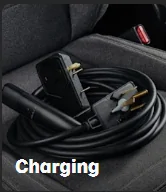
Something like this. Screen shot pulled from the "Essentials" pull down. Can't find anything bigger.
1782659708650-yn.webp


I get the feeling that that 15 amp, 120v plug version is an abandoned idea.
I’d guess it does what my TIG welder does. It has a regular NEMA 6-50R (probably 15-50 for the ev charger) which then adapts to a 120V plug. Then the onboard electronics detect the voltage and handle converting it to the right DC voltage accordingly.
 

GaRailroader

Well-Known Member
First Name
PJ
Joined
Apr 26, 2025
Threads
15
Messages
578
Reaction score
1,009
Location
Atlanta, GA
Vehicles
2026 Tesla Model Y Premium, 2018 Tesla Model 3 LR, 2027-Q2 Slate Pick-Up
I agree that the vast majority of the people, including myself, could get by with Level 1. The efficiency nerd in me demands level 2. When I got my first Tesla in 2018 I did an experiment where I measured the kWh dispensed from the outlet and compared that to the kWh received at the battery for both Level 1 and Level 2. With Level 1 only about 80% of the electricity dispensed makes it to the battery whereas with level 2 you get more like 90% into the battery.

In round numbers: If you drive 12k miles per year and average 3 miles per kWh you would have consumed 4000 kWh through the battery. Had you charged with Level 1 then you would have paid for 5000 kWh to use the 4000 kWh versus 4500 kWh on Level 2. The difference in this example between Level 1 and Level 2 is 500 kWh. If your price for electricity is 25¢ per kWh then using level 1 is a $125 annual cost over what you would have paid for if you were set-up for Level 2. Not a huge amount but a difference none the less.
 

FlyHappy

Well-Known Member
First Name
Mitchell
Joined
Jun 22, 2026
Threads
0
Messages
78
Reaction score
137
Location
USA
Vehicles
A fleet of dogs
Thanks. I just checked the breaker box and my 240 is on a 30 amp circuit. An electrician installed it for my daughter’s welder. Has anyone read if 30A will be sufficient or will I need to upgrade to a 50A?
HootOwls
You almost certainly want to replace the receptacle itself that was used for the welder (I assume the welder is no more) to an "EV rated" receptable that handles continuous loads (regardless of amperage). The terminals actually need to be "torqued to spec".

If welder is still in use, this changes your calculus a bit, but what you don't want to do is to continually plug/unplug in that or any receptacle. Hard wired is best, but completely fine to start with provided plug style first to get a feel for things, or leave the EVSE plugged forever (assuming EV rated receptacle).

Ok, just checked; my primary 240v for the dryer is 30amp so I should be GTG for the few occasions I need a faster charge. Thanks!
You may want to look at the actual dryer receptable (by unplugging) to see what type it is (10-30R or 14-30R) , it is probable that the included EVSE (cord) with the SLATE won't directly plug to it. Yes, adapters are available, but not really ideal.

Is the dryer receptacle reachable from where the car would be? Is it in a garage or something?

There are devices out there that facilitate the "sharing" of a circuit like that, ie - keeps drying and EVSE plugged in, but only allows one to operate at a time. For most people, the expense of that is best put towards a proper dedicated circuit install; this alternative is most useful for folks that have very small overall service in the home, renters, etc.


I was concerned about the statement of a 50amp breaker being fed by 10 gauge.
right, gotcha. that's no bueno ;)
 
 
Top