
No Vehicle to Load or Outlets in Bed/Frunk

Driven5

Well-Known Member
Joined
Jul 8, 2025
Threads
2
Messages
216
Reaction score
354
Location
WA
Vehicles
F150
The question is not if 7.2kW can power 'a' home, but if it can power 'your' (all electric) home. If you don't know your actual peak draw requirement, you could be in for a very expensive disappointment right when you need it most.

For example: That first 'I powered my house with the F150 hybrid' result from C&D was pure fluff that did not even run any electric heat or a/c, which along with the fridge and maybe water heater, is the whole point IMO.
 
Last edited:

sodamo

Well-Known Member
First Name
David
Joined
May 19, 2025
Threads
7
Messages
1,063
Reaction score
1,240
Location
Big Island Hawaii
Vehicles
Tundra 1794, Subaru Ascent
"Prolonged freezing temperatures in February 2021 gripped Texas for nearly a week, pushing demand to record levels and knocking power plants and natural gas systems offline as equipment froze and fuel supplies failed. More than 4 million people lost electricity, contributing to more than 240 deaths statewide." 2021 Texas Blackout

Fortunately, I was not in the worst of it but in an all electric home going a day and a half without heat was a wakeup call for me.

My neighbor had a diesel generator but had to drive somewhere that had electric power to run their diesel pumps for fuel for the generator. It makes you think.

Circling back, I am beginning to think that a Ford F150 hybrid with a full tank of gasoline might offer the best long term solution for enduring a long term blackout in comfort.

The extra cost of buying a hybrid is less than a power wall or Generac with a 500 gallon propane tank. How many 20-lb propane bottles would it take to run a house for a week?

But I could be wrong. I often am.
How many times you need refill that F150 with gas, assuming it’s available
 

Mad Mac

Well-Known Member
First Name
Mac
Joined
Apr 26, 2025
Threads
4
Messages
101
Reaction score
124
Location
Texas
Vehicles
2021 Jeep Gladiator Rubicon, 1998 Jeep Wrangler Sahara

beatle

Well-Known Member
Joined
Jan 13, 2026
Threads
1
Messages
152
Reaction score
278
Location
Springfield, VA
Vehicles
'23 R1T, '97/25 Miatas, '19 Monkey
Assuming the house survives the storm trying to cool down in comfort with air conditioning would be the challenge at my age. Air conditioning is a heavy draw.
A portable AC unit (window mount or freestanding) would do well to keep you cool in a single room during an outage. Some now are "reversible" and will also provide heat. This is my plan. It can be satisfying to "conquer the outage" and go about your regular activities in total comfort, but that gets very expensive. Powering an entire house AC takes a lot more even if you only have a small AC (my house only has a 3 ton).

Right now I have a $450 Anker Solix C1000 that I use to buffer the output of my R1T which only has a 120v 15A outlet. The Anker surges up to 3kw which is enough to run my gas furnace or portable AC, a freezer, and 2 refrigerators while preventing the truck's circuit from tripping. When I turn in my R1T next year, I will probably just charge the Anker with my small Honda generator. There are more powerful power stations that can output more, but the essentials really aren't that demanding if you're just trying to get by.
 

KevinRS

Well-Known Member
First Name
Kevin
Joined
Jul 4, 2025
Threads
4
Messages
904
Reaction score
1,081
Location
California
Vehicles
Nissan Versa
I have a whole house backup generator with three 120 gallon tanks. Will last for a bit less than a week, and a refill is a phone call away. The whole install was around $12,000. Yea, that's a chunk of money, but I've been weeks without power during three hurricanes (two in CT, one in NC). I am prevented from solar by covenants.

That's just me. I look forward to the day when I have whole house batteries, and solar, and V2L, and the generator. I think the future is solar and battery. nonflammable whole house batteries will be dirt cheap in a decade. I predict by 2035 all new houses will come with them, mandated by building code.

Just a thought about V2L. Power here in Asheville was gone for weeks - some people for months. So a V2L solution is fine as long as you can recharge that vehicle. Which you cannot do during a natural disaster that takes the regional grid down for weeks. Not disrespecting V2L - it's cool. But just be aware it doesn't create power. It redistributes what you currently have in the car. And if you need to drive during an extended power outage, well choose house or driving.
Keep an eye out on the laws about those covenants. It's usually state by state, but some states override the covenants: everyone is allowed to install solar if it's a viable possibility, and all new construction must have solar installed.
 

AZFox

Well-Known Member
Joined
Apr 29, 2025
Threads
40
Messages
1,697
Reaction score
2,372
Location
Arizona
Vehicles
Honda NC700X
FWIW, in AZ HOAs can't prohibit installing solar panels.

There's an Arizona Residential Solar Energy Act (A.R.S. § 33-439) that insures homeowners' rights to install solar energy devices.
 

Mad Mac

Well-Known Member
First Name
Mac
Joined
Apr 26, 2025
Threads
4
Messages
101
Reaction score
124
Location
Texas
Vehicles
2021 Jeep Gladiator Rubicon, 1998 Jeep Wrangler Sahara
Texas does not have a state-mandated, universal net metering policy, but many Retail Electric Providers (REPs) and municipal utilities offer solar buyback plans, allowing homeowners to receive credits for excess energy sent to the grid.
https://meterplan.com/help/how-solar-billing-works

Mine provides 1-to-1 credit at the retail rate. Better than a jab in the eye with a sharp stick.
 
  • Like
Reactions: Ali

KevinRS

Well-Known Member
First Name
Kevin
Joined
Jul 4, 2025
Threads
4
Messages
904
Reaction score
1,081
Location
California
Vehicles
Nissan Versa
Yeah, California used to, until they switched to nem 3.0. Basically you want batteries with your solar now, to charge midday and discharge during peak hours. Get quotes from multiple companies, and be sure batteries are part of it.
 

Mad Mac

Well-Known Member
First Name
Mac
Joined
Apr 26, 2025
Threads
4
Messages
101
Reaction score
124
Location
Texas
Vehicles
2021 Jeep Gladiator Rubicon, 1998 Jeep Wrangler Sahara
Evidently I am not intelligent enough to understand how disincentivizing homeowners and businesses from installing solar will produce more clean energy, decrease our dependence on foreign oil and move us toward energy independence.
 

Mad Mac

Well-Known Member
First Name
Mac
Joined
Apr 26, 2025
Threads
4
Messages
101
Reaction score
124
Location
Texas
Vehicles
2021 Jeep Gladiator Rubicon, 1998 Jeep Wrangler Sahara
The next thing will be to tax our EVs for the miles traveled since we will not be paying the 60 to 70 cents per gallon excise tax on gasoline.

Oh wait. Vermont and Utah are already charging an odometer tax, a vehicle miles traveled tax (VMT), and other states are considering it.
 

phidauex

Well-Known Member
First Name
Sam
Joined
Nov 24, 2025
Threads
0
Messages
65
Reaction score
123
Location
Boulder, CO
Vehicles
2021 Mach E AWD, 1997 Tacoma ExCab
Evidently I am not intelligent enough to understand how disincentivizing homeowners and businesses from installing solar will produce more clean energy, decrease our dependence on foreign oil and move us toward energy independence.
The problem is purely physics - CAISO already produces so much solar that during the daytime most of the year there is nowhere to put it all. They routinely go negative and export power to the neighboring grids when they can, but even that isn't always enough. Adding additional rooftop solar there is the right mindset, but without the addition of batteries, new incremental solar doesn't help. I know it is frustrating for homeowners, but there isn't really a way around the physics - load and generation must be matched 100% at all times.

Texas will be there in a few years, it is the second largest producer of renewables after CA, but a higher fraction of it is from wind power, so they can continue to take more rooftop solar for a bit longer. Many other parts of the country can take a lot more rooftop solar yet.
 

KevinRS

Well-Known Member
First Name
Kevin
Joined
Jul 4, 2025
Threads
4
Messages
904
Reaction score
1,081
Location
California
Vehicles
Nissan Versa
A big part of it is basically with NEM 2.0 they were paying you retail rates as a supplier. If they are paying you the same rate they are charging another customer with no solar to use the power, they make no money to maintain the system, do bookkeeping, and the all important profit.
They have long term contracts with hydroelectric and other producers where they have to take that power, and can't have them curtail mid-day production, when really those are the ones that should curtail, and save the power for peak times.
I don't think they quite got to the point where more solar is being produced at any time than power is being used, but part of the problem is when the sun goes down and everyone's ACs are still running, there is a sharp peak in net demand. So yes lots of peak shifting batteries are needed, both distributed at homes with solar, and grid scale storage projects, but the grid scale ones keep running into NIMBY attitudes. To me, if people in an area want to block that kind of project, they should have to sign off on being isolated from the benefits, they get the brownouts and rolling blackouts.
 

Tom Sawyer

Well-Known Member
Joined
Jan 11, 2026
Threads
0
Messages
136
Reaction score
97
Location
Northeast Ohio
Vehicles
CJ-7
A big part of it is basically with NEM 2.0 they were paying you retail rates as a supplier. If they are paying you the same rate they are charging another customer with no solar to use the power, they make no money to maintain the system, do bookkeeping, and the all important profit.
Lots of good points with one exception to your point regarding net metering rates. I'm not sure how all electric utilities do it nationwide but locally billing has a consumption component and a distribution component. The distribution portion of the bill covers maintaining the infrastructure to deliver and distribute the electricity and thus, make money to maintain the system.
 

Mad Mac

Well-Known Member
First Name
Mac
Joined
Apr 26, 2025
Threads
4
Messages
101
Reaction score
124
Location
Texas
Vehicles
2021 Jeep Gladiator Rubicon, 1998 Jeep Wrangler Sahara
Right. My electric co-op bill breaks it down.
Bill Page
Unfortunately this one has no credit for solar energy delivered to the grid by the homeowner but if it did it would be at the same rate per kwh as energy delivered.

The co-op changed out my electric meter at no charge for a dual meter that measures both ways.

I could be wrong, I often am, but I suspect that lobbying by powerful regulated utility companies at the state level is working to disincentivize consumers from installing solar panels. That's not the way we are doing it here under the Texas sky and abundant sunshine.
 

phidauex

Well-Known Member
First Name
Sam
Joined
Nov 24, 2025
Threads
0
Messages
65
Reaction score
123
Location
Boulder, CO
Vehicles
2021 Mach E AWD, 1997 Tacoma ExCab
I could be wrong, I often am, but I suspect that lobbying by powerful regulated utility companies at the state level is working to disincentivize consumers from installing solar panels. That's not the way we are doing it here under the Texas sky and abundant sunshine.
It's both - there are definitely utilities opposed to net metering simply because it treads on their ground and they don't like it. But more and more, renewables have been doing great, and now we are reaching physical constraints.

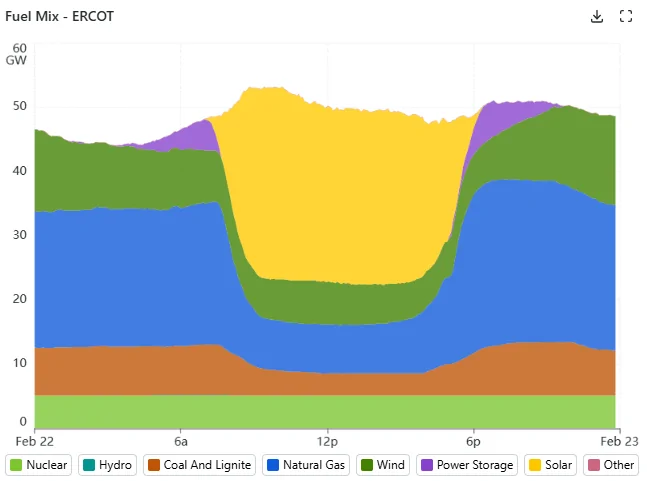
Here is ERCOT's fuel mix yesterday, it was running around 73% renewables all through the day, mix of solar and wind. This doesn't even take into account behind-the-meter solar, so actual solar generation will be somewhat higher than this graph can see.

Slate Auto Pickup Truck No Vehicle to Load or Outlets in Bed/Frunk 1771859869468-u7


The nuclear can't really be turned off effectively, so it runs as the flat baseload. Coal and natural gas facilities have minimums as well, so can't be shut all the way off without a contingency plan. Wind and solar covered the day, wind covered a lot of the night, and battery storage trimmed the morning and evening peaks. You can see with more wind and solar being built, there will be more daytime curtailment in coming years, and not everyone will be able to offer simple net metering.

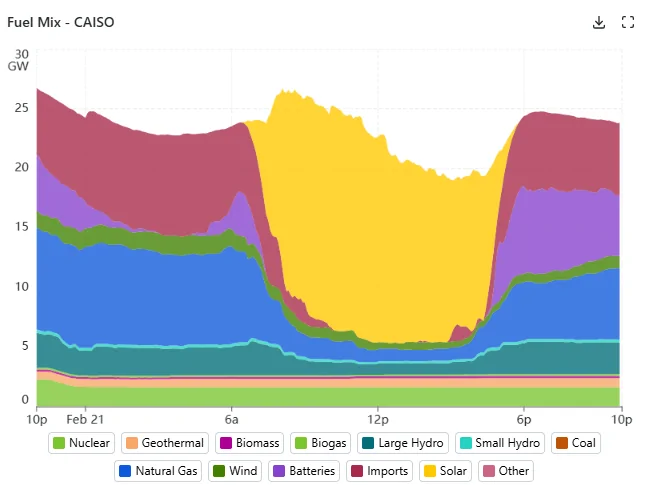
Same graph in CAISO, from two days ago, and you can see the situation is a lot more dramatic.

Slate Auto Pickup Truck No Vehicle to Load or Outlets in Bed/Frunk 1771860079212-ol


Solar and wind, through the main part of the day, were at >100% of the load, peaking at 145% of load. Some of that excess was exported, a lot was charged into batteries (look how big the purple block is - that is grid scale energy storage), and nearly 6GW was curtailed (simply lost).

In CAISO, any kW of solar you put on a home or business will be offset by a utility solar plant having to curtail one kW - no net benefit to the people of CA. Its OK, it is a good problem to have, but strategies have to change as renewable penetration goes up.
 
 
Top